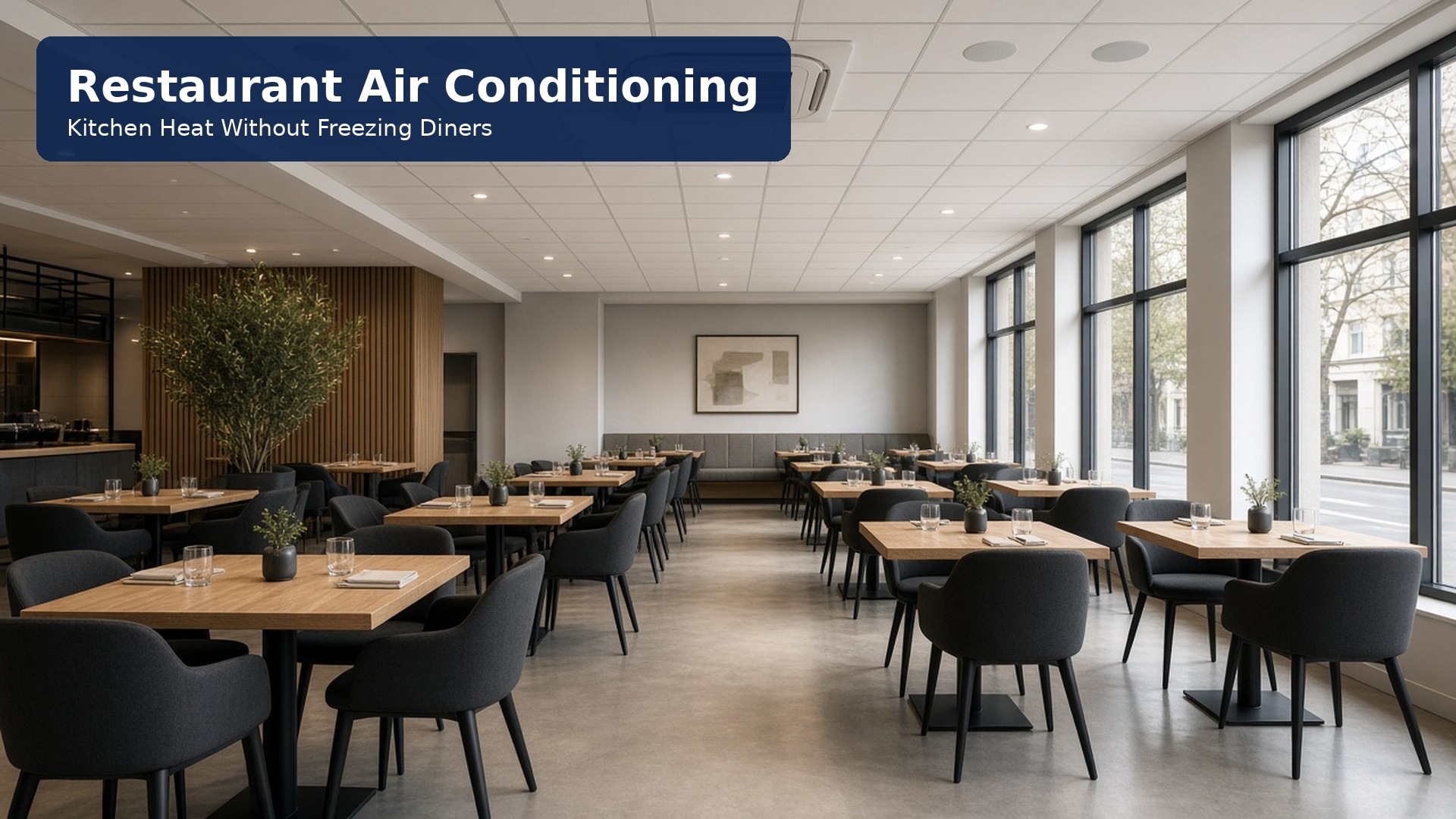
Restaurant air conditioning for UK businesses is rarely about picking the biggest cassette and hoping for the best. Kitchen heat, busy covers, open pass lines and guest comfort pull in different directions. Cool the dining room too hard and coats stay on. Ignore the kitchen and service staff bake through every service.
This guide helps restaurant businesses balance kitchen heat and front-of-house comfort without freezing diners. We cover load differences, how cooling interacts with ventilation at a high level, cassette, ducted and split options, noise and outdoor siting, summer peaks, when spot cooling is enough, and when a survey beats a brochure. When you want eyes on the site, Commercial AC Installation can arrange support with trusted installers and a free site survey.
Why restaurant kitchens and dining rooms need different cooling
A restaurant is not one thermal zone with nice furniture. The kitchen is a process space. The dining room is a comfort space. Treating them as identical is how businesses end up with icy banquettes and a pass that still feels tropical.
Kitchen heat comes from hobs, ovens, fryers, dishwashers, lighting and people moving fast. Much of that heat and moisture should leave through extract. What remains still raises air temperature and radiant load on staff. Front-of-house heat comes from guests, lighting, solar gain through shopfront glass, open doors, and warm air drifting from the kitchen or open pass.
Guest comfort is unforgiving. Draughts across tables, cold spots near vents, and noisy indoor units all show up as reviews and shorter dwell time. Staff comfort matters for retention and food safety habits. Neither problem is solved by a single thermostat in the wrong place.
UK summers add peaks: full bookings, doors propped open, and condensers working harder on hot afternoons. A system that “felt fine” in May can struggle in August if sizing ignored real covers and solar gain.
Kitchen heat, grease and ventilation (high level)
Comfort cooling and kitchen ventilation must cooperate. They are not the same job.
Kitchen extract removes heat, steam, grease and odours. Make-up air replaces what the extract pulls out. If make-up air is weak, hoods underperform and adjacent dining areas suffer. If you add air conditioning without thinking about air paths, you can cool some air while extract fights you, pull greasy air toward coils, or create pressure problems between kitchen and FOH.
Practical survey points for businesses (not a full kitchen extract design brief):
- Where does extract discharge, and where might outdoor AC plant sit without conflict?
- Is the pass open to diners, and how much kitchen air drifts FOH?
- Are there grease filters and access routes that collide with proposed indoor units?
- Will condensate, pipework and filter access work in a busy kitchen ceiling?
Air conditioning can improve kitchen staff comfort when ventilation alone still leaves air too warm. It should not be sold as a replacement for extract. Grease-laden air and comfort coils are a poor combination if units are poorly placed. High-level coordination with your ventilation designer or installer matters before anyone drills a hole.
For broader maintenance discipline once plant is in, see commercial air conditioning maintenance.
Restaurant air conditioning options for businesses
When businesses search for restaurant air conditioning, they usually choose among a few practical families for dining rooms and support spaces:
- Ceiling cassettes, even throw across covers when the grid allows
- Ducted systems, discreet grilles, useful where the look must stay clean
- Wall-mounted splits, smaller rooms, offices, staff areas, some bars
- Multi-split or light VRF, several zones from fewer outdoor positions
| Option | Often suits | Pros | Cons / watch-outs |
|---|---|---|---|
| Cassette | Dining rooms with ceiling grid | Even distribution, tidy look | Needs void and access; poor placement causes draughts on tables |
| Ducted | Design-led FOH, listed interiors | Discreet, flexible grille positions | Design quality matters; filter and grille access must be planned, see ducted air conditioning |
| Wall split | Small dining rooms, offices, back-of-house | Lower cost, quicker install | Visible; limited for large open dining; outdoor units multiply if you keep adding rooms |
| Multi-split / light VRF | Kitchen staff areas + FOH + offices | Zoning, fewer outdoor footprints | Needs proper design; kitchen and dining should not share one blunt setpoint, compare multi-split vs VRF and VRF/VRV |
Offices above the restaurant, private dining, and staff rooms often follow the same logic as other commercial spaces. Our office air conditioning guide covers that layout family in more depth.
Noise, outdoor siting and summer peaks
Dining rooms punish noisy plant. Guests notice fan roar and cold jets more than brochure SEER numbers.
Indoor units should be selected and commissioned for evening service sound levels, not just nameplate capacity. Oversizing that leads to short cycling, or undersizing that forces continuous high fan, both hurt comfort. Air direction matters around banquettes and window seats.
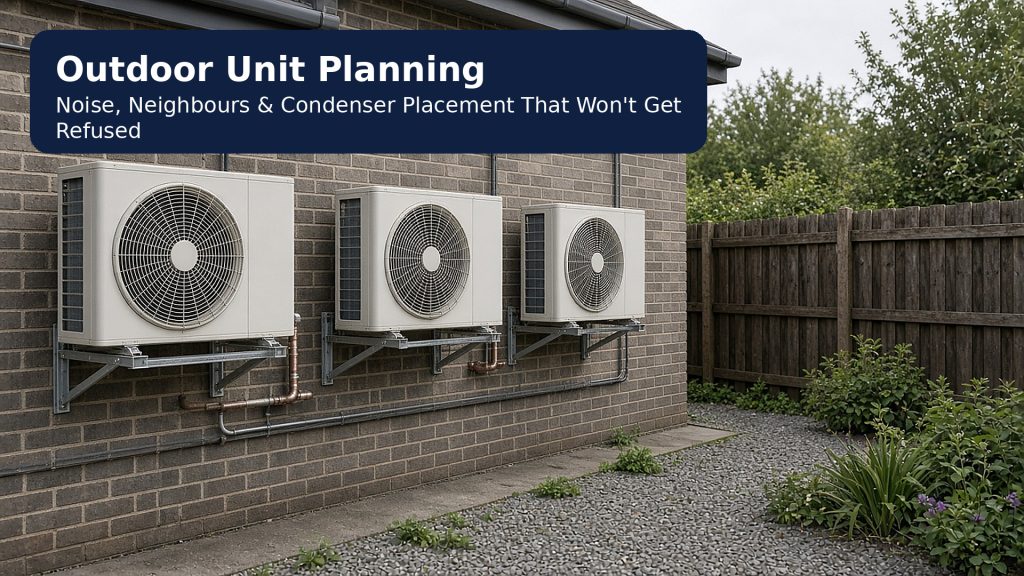
Outdoor condensers need airflow, service access, and neighbour-friendly placement. Alleys, flat roofs, yards behind beer gardens and residential windows all create different constraints. Commercial plant often needs planning permission; landlord or freeholder consent is a separate track. Noise assessments commonly follow approaches such as BS 4142 rather than a single nationwide dB “legal limit”. This is practical guidance, not legal advice: check your local planning authority and lease.
Summer peaks combine full covers, solar gain and hotter outdoor air. Doors open for smokers or deliveries undo careful FOH cooling. Controls and zoning help; so does honesty about how the room is actually used at 7pm on a Friday in July.
Running costs follow hours of use, setpoints and maintenance more than slogans. For orientation, see commercial air conditioning running costs.
Spot cooling versus full restaurant air conditioning
Not every hospitality business needs a full dining-room scheme on day one.
Spot or local cooling can make sense when:
- You only need relief at a pass, bar well, or small prep corner
- Outdoor plant space or budget cannot yet support full FOH coverage
- You are testing a concept site before a larger refurb
Full comfort cooling is usually the better brief when:
- Covers sit in an open dining room that must feel even
- Reviews already mention heat or cold draughts
- You are fitting out for year-round guest expectations
- Kitchen drift and shopfront glass create clear FOH heat gains
Portable units are a short-term patch, not a substitute for designed plant in a busy restaurant. They trip circuits, block aisles, and dump heat somewhere else.
Pros, cons and when restaurant AC is not the right fit
Cassette and ducted FOH, pros and cons
Pros: Even guest comfort when designed well; professional look; workable with zoning. Cons: Install disruption in fitted dining rooms; poor grille or cassette placement creates draughts; filter access must not fight the fit-out.
Kitchen-adjacent comfort cooling, pros and cons
Pros: Can improve staff conditions where extract alone still leaves air hot. Cons: Wrong placement near grease-laden air shortens equipment life; must not replace extract design; high moisture and cleaning regimes are harsher than offices.
When it is not the right fit
Restaurant comfort AC is the wrong primary answer when:
- The real problem is inadequate kitchen extract or make-up air
- You have no viable outdoor plant location and no alternative strategy
- A single tiny room only needed a staff-area split, not a dining-room scheme
- The building already has workable plant that mainly needs maintenance or better controls
Sometimes the honest survey outcome is ventilation first, then cooling. That still saves money compared with buying the wrong system twice.
How Commercial AC Installation can help
Commercial AC Installation helps UK restaurant businesses arrange support with trusted installers for kitchen-aware and dining-focused cooling. A free site survey or quote typically covers kitchen versus FOH loads, outdoor siting, noise, and how comfort plant should sit alongside extract.
We will not pretend a catalogue cassette fixes a ventilation gap, or that every kitchen needs the same plant as the dining room. The survey should match how you actually serve: covers, pass layout, hours, and neighbours.
When you are ready, contact Commercial AC Installation to request a quote or book a free site survey for restaurant air conditioning, or start from our commercial air conditioning installation page.
What is the best restaurant air conditioning for businesses?
There is no single best system. Dining rooms often suit cassettes or discreet ducted outlets; kitchens need a plan that works with extract and make-up air rather than fighting them; bars and reception may need quieter splits or smaller zones. The right mix depends on kitchen heat, covers, ceiling type, outdoor plant space and noise limits.
Can restaurant air conditioning cool the kitchen and dining room with one system?
Sometimes, but kitchen and front-of-house loads behave differently. Kitchens produce intense process heat plus steam and grease-laden air that must be extracted; dining rooms need gentle comfort without cold draughts on guests. Many businesses use separate zoning or different indoor types on a shared outdoor plant, or keep kitchen comfort cooling modest and focus refrigerant cooling on FOH.
Does restaurant air conditioning replace kitchen extract ventilation?
No. Comfort cooling is not a substitute for properly designed kitchen extract and make-up air. Grease, odours and combustion products need dedicated ventilation. Air conditioning can help staff comfort and temperature control, but it must be coordinated with extract so you do not starve hoods of air or dump grease onto coils.
How noisy is restaurant air conditioning for diners?
Indoor unit noise and air throw matter in dining rooms. Cassettes and ducted systems can be quiet when sized and commissioned properly; undersized units running flat out are louder and create draughts. Outdoor condensers near neighbours or beer gardens also need careful siting. Ask for sound data and think about evening service, not just lunch peaks.
When is spot cooling better than full restaurant air conditioning?
Spot or local cooling can help a pass, bar, or small prep area when a full FOH scheme is not yet justified, outdoor plant space is limited, or you only need short-term relief. It is usually the wrong answer for a busy dining room that needs even comfort across covers, or where you are trying to fix a ventilation problem with a portable unit.
How can Commercial AC Installation help with restaurant air conditioning?
Commercial AC Installation can arrange support with trusted installers for a free site survey or quote. That typically covers kitchen versus dining loads, outdoor siting, noise, and how cooling should sit alongside extract, without locking you into a catalogue pick before the building is understood.