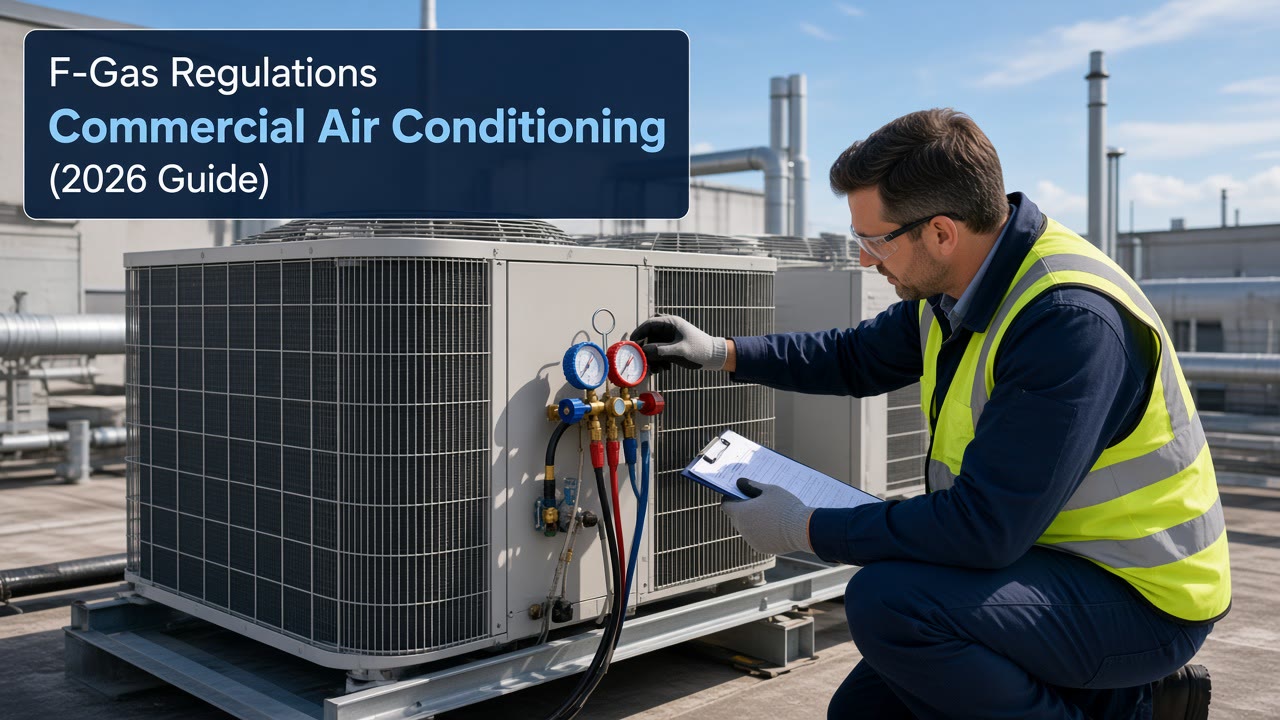
If you run a building with commercial cooling, F-Gas regulations commercial air conditioning rules are not optional paperwork. They sit behind leak checks, engineer qualifications, refrigerant choices and — increasingly — whether keeping an older system makes financial sense.
This guide is for UK businesses and facilities managers: what the rules mean, who the operator is, leak-check frequency by tCO2e, records, 2026 high-GWP notes, and how requesting a quote works when you want help arranging support with trusted installers.
What F-Gas rules mean in plain English
F-gases (fluorinated greenhouse gases) include the HFC refrigerants used in a huge amount of commercial air conditioning and heat-pump plant. Many of those gases have a high global warming potential (GWP) — meaning a small leak can equate to a large amount of CO2 in climate terms.
UK F-Gas rules (retained and applied after EU exit, with Great Britain and Northern Ireland nuances) aim to:
- Contain refrigerant — stop leaks and fix them promptly
- Qualify the people who handle it — F-Gas certified engineers and companies
- Phase down how much high-GWP HFC can be placed on the market over time
- Record what happens on systems above set charge thresholds
You do not need to memorise regulation numbers. You do need to know your system’s refrigerant type, charge size in tonnes of CO2 equivalent (tCO2e), and who is responsible for compliance day to day.
Quick tip: CO2e is charge in kg × GWP ÷ 1,000. Your nameplate, logbook or installer paperwork should help. If not, a survey from an F-Gas certified engineer can establish it.
Who is the “operator”? (Responsibility does not vanish if you outsource)
Under F-Gas, the operator is usually the person or business with technical control of the equipment — free access, day-to-day running, and the power to decide on repairs or modifications. In most offices, shops, warehouses and leisure sites, that is the owner, landlord (depending on lease) or facilities manager — not the visiting contractor.
Outsourcing maintenance is normal and sensible. It does not hand the operator’s legal duty over to the maintenance company by default. You remain responsible for making sure:
- Leak checks happen at the required frequency
- Leaks are repaired without delay and rechecked
- Records exist and are retained
- Only properly certified people handle the refrigerant
If you rent plant, check the contract carefully — sometimes the rental company carries operator duties. If you own it and just buy PPM visits, assume you are still the operator.
F-Gas leak check frequency by tCO2e (UK commercial AC)
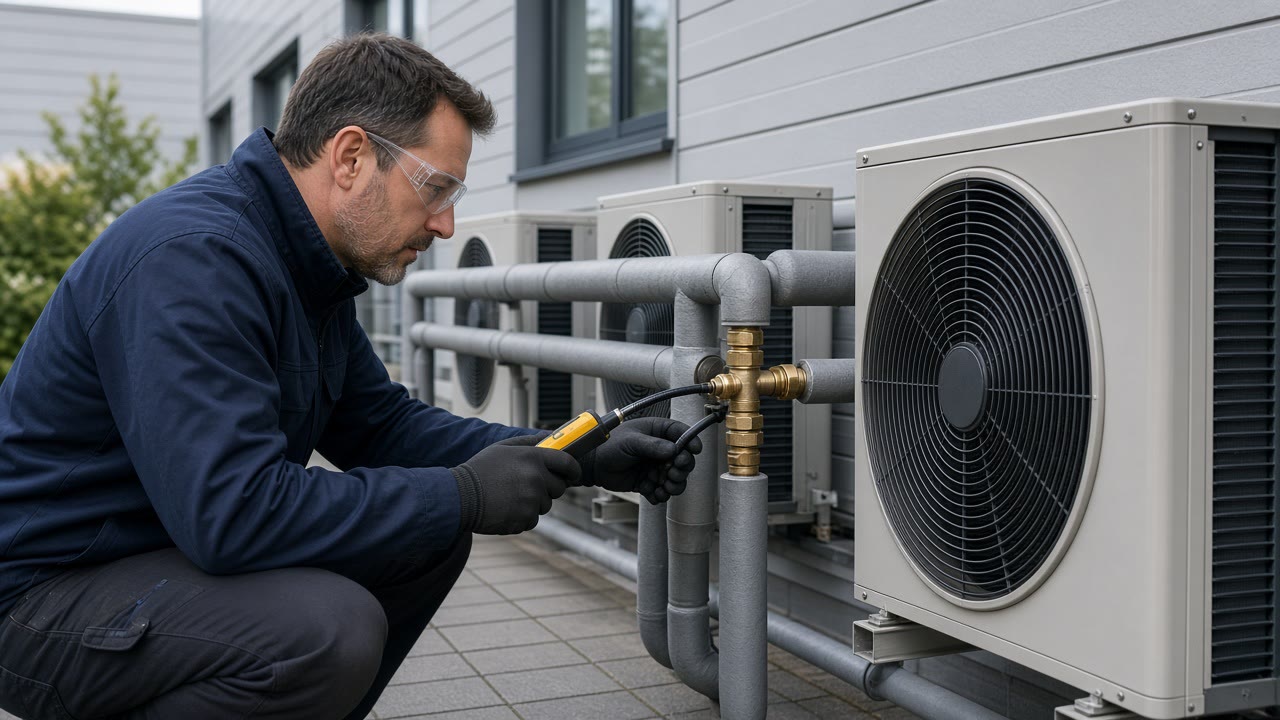
Mandatory leak-check intervals for stationary commercial air conditioning are driven by total refrigerant charge in tCO2e, not by “how big the building feels” or cooling capacity alone.
| Refrigerant charge (tCO2e) | Minimum leak check frequency | With working automatic leak detection |
|---|---|---|
| Below 5 tCO2e* | No mandatory interval under the standard threshold | — |
| 5–49 tCO2e | At least every 12 months | At least every 24 months |
| 50–499 tCO2e | At least every 6 months | At least every 12 months |
| 500+ tCO2e | At least every 3 months | At least every 6 months |
\*Hermetically sealed refrigeration and air-conditioning systems labelled as hermetically sealed are generally outside mandatory leak-check intervals if they contain less than 10 tCO2e — confirm against current GOV.UK guidance for your kit type.
Extra rules that trip people up:
- At 500 tCO2e or more, automatic leak detection is generally required for stationary refrigeration, air-conditioning and heat-pump equipment (GOV.UK notes limited historic exceptions for certain electrical switchgear / organic Rankine cycle equipment).
- Where fitted on AC plant, automatic leak detection must be checked so it still works — at least once every 12 months.
- If a leak is found, repair it as soon as possible and repeat the check within a month to confirm the repair worked.
That is why F-Gas leak check frequency belongs on the facilities calendar, not in a drawer with last year’s invoices.
Records retention: keep them for about five years

For equipment that needs leak checks (generally 5 tCO2e or more), operators should keep clear records for at least five years. Contractors who work on the kit should keep copies for the same period.
Typical contents include:
- Type and quantity of refrigerant installed
- Gas added during maintenance or leak repair
- Dates and results of mandatory leak checks
- Identity and certification details of companies / engineers used
- Recovery and disposal information when plant is decommissioned
- Recycled or reclaimed gas details where relevant
The Environment Agency (or equivalent competent authority) can ask to see records. A tidy digital logbook per asset is usually enough — as long as it is complete and findable.
2026 and high-GWP refrigerants: what actually changes (without the panic)
There is a lot of noise around F-Gas 2026 air conditioning. Here is the calm version for UK businesses.
1. Virgin high-GWP servicing restrictions already exist From 1 January 2020, for some larger refrigeration systems (not typical comfort-cooling AC), virgin (new) refrigerant with a GWP above 2,500 cannot be used for servicing or maintenance where the charge is 40 tCO2e or more. That has bitten high-GWP gases such as R-404A / R-507A on bigger cold rooms and similar plant. Under current Great Britain rules, reclaimed or eligible recycled gas with GWP above 2,500 may still be used to service affected refrigeration systems until 1 January 2030 (with labelling/use conditions). Your engineer should confirm the current position for your exact system.
2. Phase-down keeps tightening supply Even where that hard servicing ban does not apply to your commercial AC refrigerant (many splits and VRF systems use gases below that GWP band), the wider HFC quota phase-down still tightens supply. Under the existing GB framework, industry planning into 2027 and beyond assumes tighter availability and higher prices for higher-GWP products.
3. No automatic “rip it out in 2026” rule for typical commercial AC You are not generally forced to scrap a working system on a calendar date. The business pressure is quieter: top-ups get dearer, specialist gases get harder to source, and a major leak on ageing high-GWP plant can turn a repair quote into a replacement conversation.
Northern Ireland follows a different F-Gas path aligned more closely with updated EU rules — if your estate spans jurisdictions, treat advice as site-specific.
Repair vs replace when refrigerant costs rise
Rising refrigerant cost is one of the strongest links between F-Gas compliance and capital planning. A small top-up on a well-contained system may still be routine. Repeated leaks, scarce gas, or a large recharge on older plant often tips the spreadsheet toward replacement with a lower-GWP, more efficient design.
For a fuller decision framework — age bands, fault patterns and when to get both quotes — see our guide on repair or replace commercial air conditioning.
F-Gas certified engineers: non-negotiable
Anyone who installs, commissions, maintains, repairs, recovers or decommissions F-Gas commercial air conditioning must hold the right individual qualifications. Companies providing those services to other operators also need the appropriate company certification.
Before work starts, ask for:
- Engineer qualification / F-Gas category relevant to the task
- Company certification details
- Confirmation they will update your logbook and leave written leak-check results
Using uncertified labour is not a saving. It is a compliance and insurance risk.
How arranging support and quotes works on this site
Commercial AC Installation helps businesses request a quote and arrange support with trusted installers — we do not physically install systems.
Typical flow:
- Share your location, premises type and need (leak checks, repair, refrigerant advice or replacement survey).
- Support can be arranged with suitable partners.
- A free site survey can be organised where appropriate to confirm charge, refrigerant and access.
- You get clear options: compliance maintenance, repair or replace.
Multi-site estates: say so up front. F-Gas commercial AC UK compliance is easier when assets, CO2e figures and due dates sit together.
Practical checklist for facilities managers (2026)
- [ ] List every stationary AC / heat-pump system and its refrigerant
- [ ] Calculate or obtain tCO2e per system
- [ ] Diarise leak checks for the 5–49 / 50–499 / 500+ brackets
- [ ] Confirm automatic detection where 500+ tCO2e applies
- [ ] Keep operator records for ~5 years
- [ ] Verify F-Gas certification before any gas-handling work
- [ ] Review high-GWP plant for repair-vs-replace cost risk
- [ ] Request a quote if you need help arranging surveys or certified support
FAQs
What are F-Gas regulations for commercial air conditioning in the UK?
They are the UK rules that control fluorinated greenhouse gases (HFCs) used as refrigerants in commercial AC and heat pumps. In practice they mean leak prevention, mandatory checks once a system hits certain CO2-equivalent thresholds, proper records, certified engineers, and a gradual phase-down of high-GWP refrigerants.
Who is the F-Gas operator if I outsource maintenance?
Usually the business with day-to-day technical control of the equipment — typically the owner or facilities manager. Outsourcing maintenance does not remove operator responsibility. You still need leak checks on schedule, records kept, and certified people doing the work.
How often do I need an F-Gas leak check on commercial AC?
It depends on the refrigerant charge in tonnes of CO2 equivalent (tCO2e). Roughly: 5–49 tCO2e at least every 12 months; 50–499 tCO2e at least every 6 months; 500+ tCO2e at least every 3 months. Working automatic leak detection can double those intervals. Systems at 500+ tCO2e generally need automatic detection fitted.
How long must I keep F-Gas records in the UK?
For equipment that needs leak checks (generally 5 tCO2e or more), operators should keep the required records for about five years. That usually covers gas type and quantity, additions and recoveries, leak-check dates and results, and details of certified companies or engineers who worked on the kit.
Do 2026 F-Gas rules mean I must replace my commercial air conditioning?
No automatic “must replace” deadline for typical commercial AC. The hard virgin high-GWP refill restriction (GWP above 2,500, charge 40 tCO2e or more) applies to certain larger refrigeration systems and has been in force since 1 January 2020. For most comfort-cooling AC, what matters into 2026 and beyond is the ongoing HFC phase-down: quota reductions keep tightening supply and price. Rising top-up costs are a business reason to weigh repair against replacement — not a panic switch-off date.
Do engineers working on commercial AC need F-Gas certification?
Yes. Anyone installing, servicing, maintaining, repairing, recovering or decommissioning F-Gas equipment must hold the right qualifications, and companies doing that work for others need the appropriate company certification. Always ask for proof before work starts.
Soft next step
Unsure of tCO2e figures, leak-check dates or whether ageing high-GWP plant is still worth keeping? Request a quote — support can be arranged with trusted installers who can survey the kit, check paperwork needs and set out repair or replace options.
Nationwide pairing for F-Gas regulations commercial air conditioning: share premises type, refrigerant (if known) and whether you need compliance checks, repairs or a replacement proposal.
General guidance for UK businesses around 2026 — not legal advice. Thresholds and GB/NI rules can change; check current GOV.UK (or NI) guidance and take site-specific advice from F-Gas certified professionals.