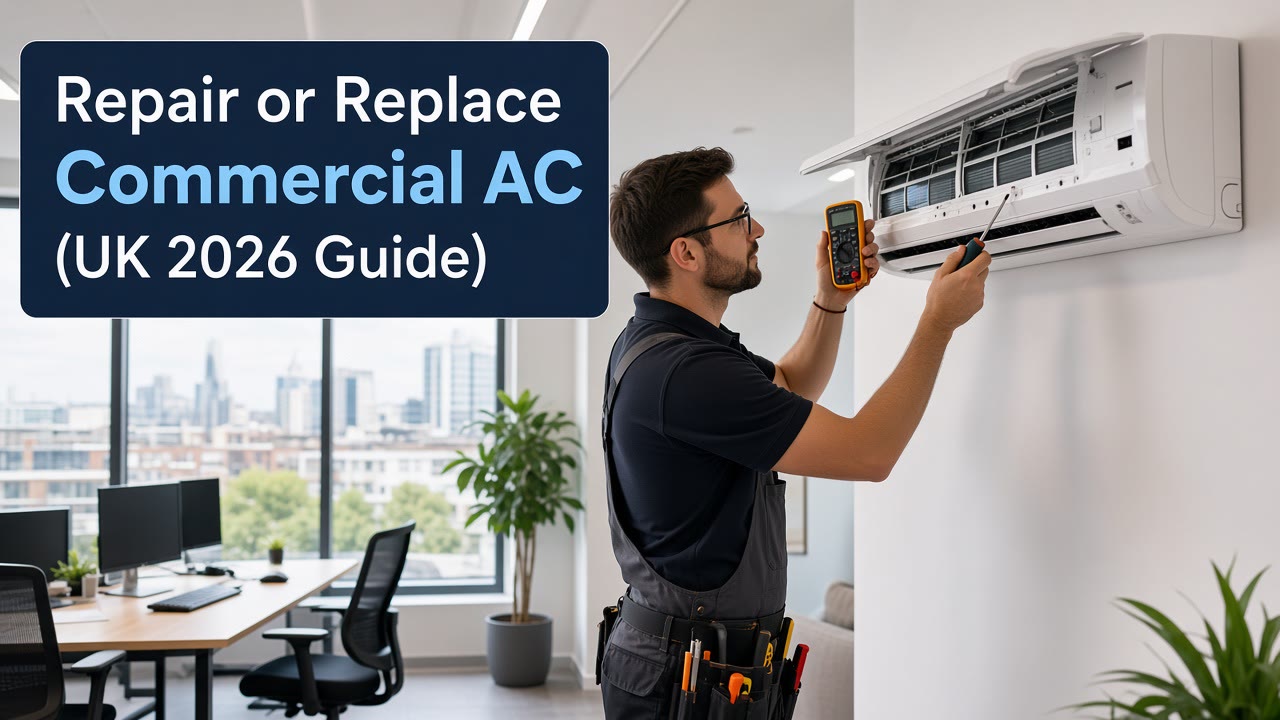
When a commercial system starts playing up, the question arrives fast: repair or replace commercial air conditioning — and which choice actually saves money?
There is no single answer for every office, shop or warehouse. Age, fault frequency, refrigerant type, energy bills and how critical comfort is to trading all matter. In 2026, F-Gas rules and high-GWP refrigerant pricing add another layer: some older plant is still repairable, but servicing can get dearer year by year.
Below: a decision framework, typical UK cost bands (guide ranges ex VAT, not quotes), plain-English refrigerant notes, and how quoting works if you want help arranging support with trusted installers.
Quick decision framework: repair vs replace commercial AC
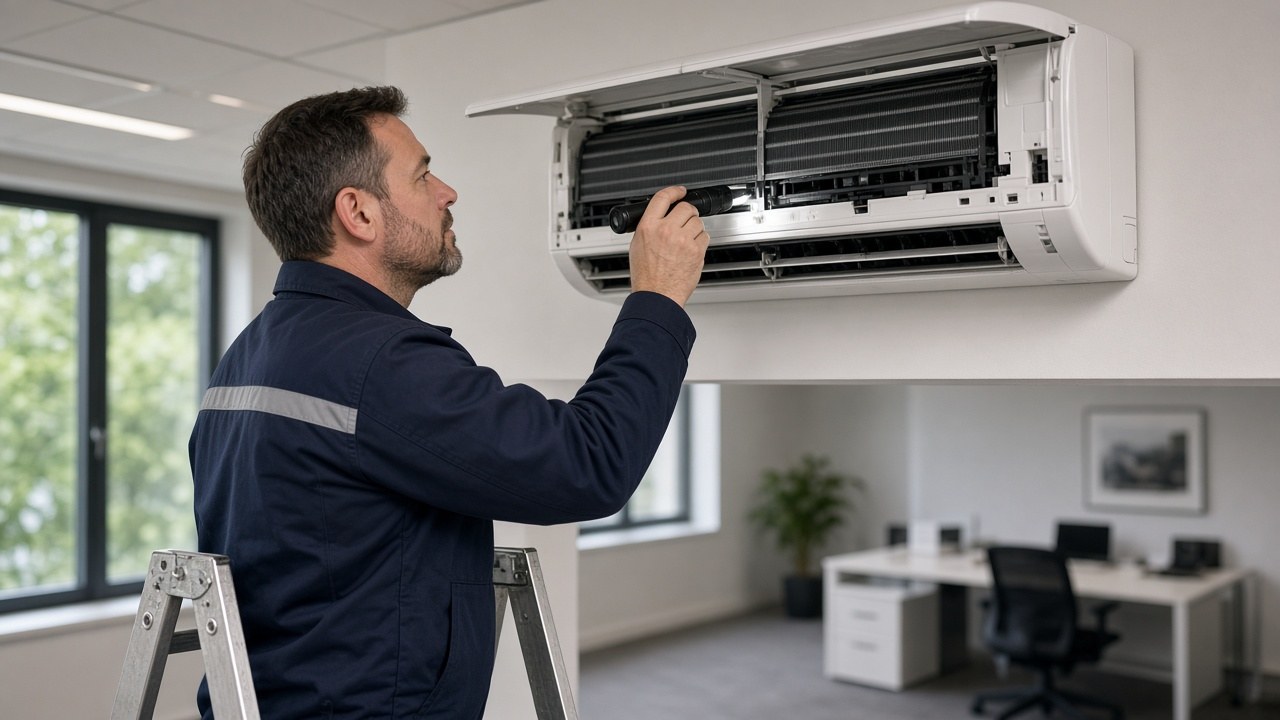
Use this as a first filter before you spend on diagnostics.
| Situation | Lean towards | Why |
|---|---|---|
| System under ~8–10 years, one clear fault | Repair | Capex still recoverable; one fix often restores reliability |
| Age ~10–15+ years, rising callouts | Replace (or quote both ways) | Parts, efficiency and downtime start to outweigh repair |
| Obsolete / high-GWP refrigerant, scarce or pricey gas | Replace often wins | Top-ups and major repairs can spike |
| Energy bills climbing with no other cause | Replace or efficiency audit | Old compressors and coils waste power |
| Refurb, layout change or new fit-out | Replace / redesign | Chance to right-size zones and routes |
| Safety, electrical or structural concerns | Replace (urgent assessment) | Do not patch around unsafe plant |
Rule of thumb: if a single repair approaches roughly half the cost of a like-for-like commercial air conditioning replacement, get a replacement quote first. Downtime, lease length and refrigerant risk can tip either way.
Signs repair still makes sense
Repair is often the sensible first move when the system is relatively young and the fault is contained.
Repair tends to win when:
- Mid-life plant — many commercial splits and multi-splits are still worth fixing well into the first decade if maintained.
- A single, diagnosable failure — fan motor, PCB, sensor, expansion valve, or a properly repaired leak under F-Gas rules.
- Good service history — a sudden fault after solid care differs from chronic neglect.
- Workable refrigerant — still sensible to source after a proper repair (not a recurring “top-up and hope” cycle).
- Minimal downtime needed — a same-week repair can keep a shop or restaurant open when a rip-out would close trading longer.
- Lease or budget timing — 12–24 months of cooling before a planned refurb can justify a bridging repair.
Ask for a written scope: cause, parts, durability, and what else is likely to fail next.
When commercial air conditioning replacement wins
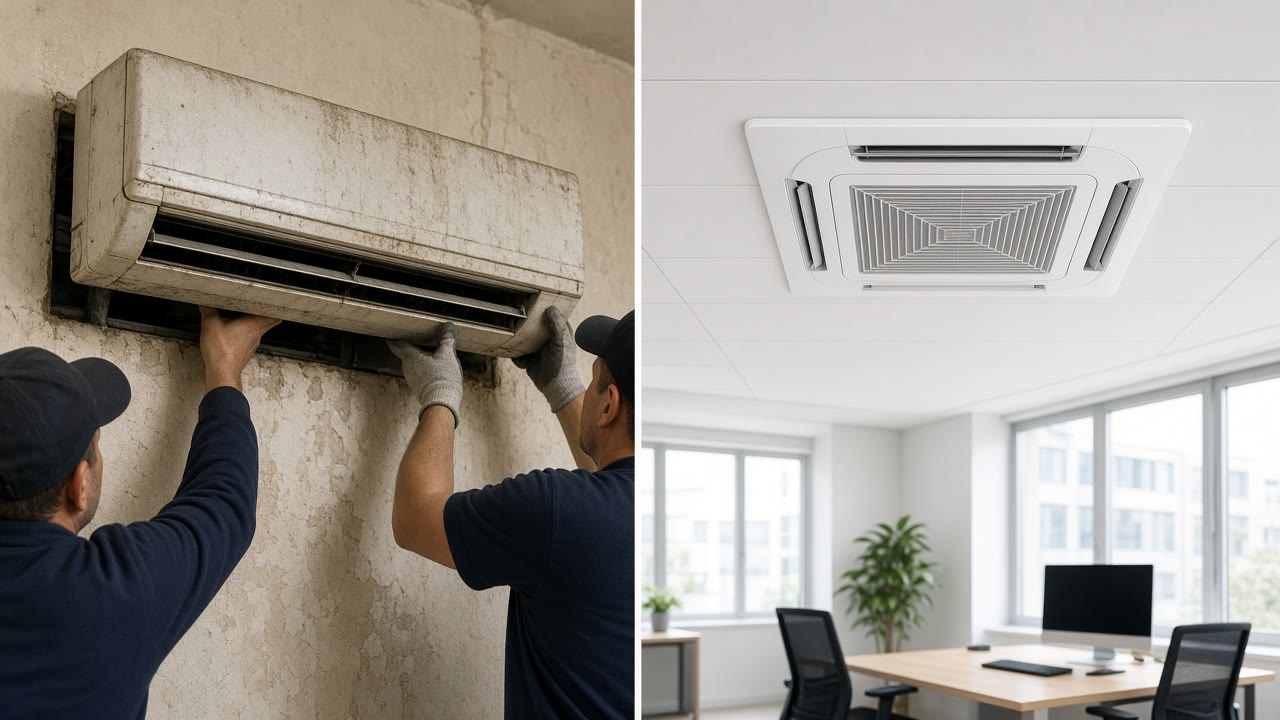
Replacement usually makes more sense once repair becomes a habit rather than an exception.
Age around 10–15 years and beyond
By 10–15 years, many systems show weaker efficiency, worn compressors and harder-to-source parts. If outdoor plant dates to a mid-2010s fit-out and you are already budgeting for major works, commercial air conditioning replacement often delivers better comfort per pound than another round of big repairs.
Repeated faults and rising callouts
Two or three significant callouts in a short period — especially the same compressor, board or circuit — are a classic signal. Labour, staff discomfort and lost sales add up. Track invoices for a season: patterns show clearer on paper than in the moment.
Obsolete refrigerant and F-Gas pressure (plain English)
Older systems may use higher-GWP refrigerants being phased down under UK F-Gas rules. That does not mean every older unit must go tomorrow. It does mean:
- Virgin high-GWP gas can be harder to get and more expensive over time.
- Major repairs needing a large recharge may cost more than a few years ago.
- Engineers still service compliant systems, but F-Gas refrigerant costs UK businesses should factor into any “just top it up” decision.
If a full recharge after a leak is scarce or pricey, replacement with modern lower-GWP kit often becomes the cleaner long-term option. No scare stories — put gas cost next to parts and labour.
Rising energy bills
If cooling (and heating, where heat pumps do both) kWh has crept up with no change in hours or occupancy, ageing plant is a prime suspect. Newer systems typically offer better part-load efficiency and smarter controls. Over several summers, energy saving can offset a chunk of replacement cost — especially in long-hours retail and hospitality.
Refurbishment and layout change
New partitions, open-plan conversions or a warehouse mezzanine often leave old pipe routes in the wrong place. A refurb is the natural moment to replace: right-size the load, improve zoning, and avoid burying obsolete plant behind new ceilings.
Rough cost thinking: repair callout vs full replacement
These are typical guide ranges for UK commercial work in 2026, shown ex VAT — not quotes. Location, access, electrics, refrigerant, height work and brand all move the number. A free site survey is the reliable way to firm things up.
Typical repair-side guides
| Work type | Typical guide range (ex VAT) | Notes |
|---|---|---|
| Diagnostic / callout visit | £150 – £350+ | Higher for evenings, remote sites or specialist plant |
| Minor repair (fan, sensor, simple parts) | £200 – £800 | Plus refrigerant if a circuit is opened |
| Mid repair (PCB, motor, leak find & fix) | £500 – £2,000+ | Leak repair must meet F-Gas requirements |
| Major repair (compressor / large recharge) | £1,500 – £5,000+ | Can approach replacement cost on smaller systems |
Commercial AC repair cost spikes with travel, access kit, obsolete parts or high-GWP refrigerant. Ask whether reclaim, recharge, pressure test and certificates are included where required.
Typical replacement-side guides
| Project scale | Typical guide range (ex VAT) | Common fit |
|---|---|---|
| Like-for-like single room / small split | £2,500 – £6,000 | Manager office, stock room, consulting room |
| Small multi-zone replacement | £5,000 – £15,000 | Shop floor, café, small suite |
| Medium commercial replacement | £10,000 – £30,000 | Open-plan office, restaurant dining, gym |
| Larger VRF / multi-zone / packaged | £15,000 – £75,000+ | Multi-floor offices, large retail, warehouses |
Strip-out, making-good, electrics upgrades and temporary cooling hire are often extra — clarify scope when you compare repair vs replace commercial AC quotes.
Practical tip: request a repair quote and a replacement option when the system is older or the repair is major.
!
F-Gas and refrigerant availability — without the alarmism
F-Gas rules limit how much high-GWP refrigerant enters the market over time. For UK workplaces, that means:
- Older systems can still be serviced by qualified engineers following the rules.
- Gas price and availability vary by type — some older refrigerants cost more for a full charge than they used to.
- Repeated leak–top-up cycles are poor practice and get expensive; a proper leak repair or planned replacement is usually smarter.
- New equipment typically uses refrigerants that fit the phase-down path better, easing future servicing risk.
You do not need to become an F-Gas expert. Ask which refrigerant you have, whether a major recharge is realistic at today’s F-Gas refrigerant costs UK, and how that compares with replacing the outdoor unit or whole system. Put that next to age, faults and energy use — then decide.
!
Office, shop, restaurant and warehouse — brief nuances
Offices — Comfort drives complaints. Multi-split or VRF replacements often win when zoning has changed; repair suits young systems with a single fault.
Shops and retail — Downtime hits sales on warm days. Fast repair protects trading; full replacement fits quieter seasons or shopfit windows. High occupancy and lighting can mean upsizing, not just like-for-like.
Restaurants and hospitality — Kitchens, dining and cellars have different loads. Grease and long hours punish kit. If dining comfort drives reviews, chronic weak cooling argues for replacement over endless mid-service callouts.
Warehouses and light industrial — Volume, door traffic and process heat dominate. Crane or rooftop access can make replacement a bigger project — but so can repeated failures on ageing rooftop units. Treat cold-chain or welfare areas separately.
How quoting works on this site
Commercial AC Installation helps businesses compare practical options and arrange support with trusted installers — not a one-size answer.
- Tell us what you need — repair assessment, replacement, or both for the same site.
- Share basics — premises type, rough size, system age if known, symptoms, and location.
- Support can be arranged with trusted installers who can advise on repair vs replace.
- Request a quote — many projects start with a free site survey so heat load, access and refrigerant realities are checked.
- You stay in control of whether to repair, replace or stage the work.
Help arrange, trusted installers, free site survey, request a quote — attending engineers specify and price the work.
FAQs
Is it cheaper to repair or replace commercial air conditioning?
For young systems with one clear fault, repair is usually cheaper short term. Major compressor work, scarce refrigerant or repeated callouts on 10–15+ year plant often tip toward replacement over a few seasons. Compare both quotes when the repair is large.
How long should commercial air conditioning last in the UK?
With decent maintenance, many systems last around 10–15 years, sometimes longer. Run hours and care matter more than the calendar. Beyond that, budget for rising repair and efficiency risk.
What is a typical commercial AC repair cost in the UK?
Guide bands often run from a few hundred pounds for minor parts up to several thousand for compressor or major leak repairs (ex VAT). Callout, access and refrigerant can add cost. Typical guides only — not fixed prices.
Do F-Gas rules mean I must replace my old system in 2026?
No automatic “must replace” rule. The practical issue is servicing cost and refrigerant availability for high-GWP gases. If a major recharge is expensive or difficult, that is a business reason to consider replacement — not a panic deadline.
Can I replace just the outdoor unit?
Sometimes, if indoor units, pipework and controls are compatible and sound. Mismatched kit can hurt reliability and warranty. A survey should confirm whether a partial swap works or full commercial air conditioning replacement is wiser.
Will a new system cut my energy bills?
Often yes when replacing inefficient older plant and improving controls or zoning. Savings depend on hours of use, tariffs and sizing. Ask for efficiency figures on any replacement proposal.
How do I get a free site survey?
Use the quote form with your location and a short description of the fault or project. Support can be arranged with trusted installers who can assess repair vs replace and provide clear options.
Soft next step
If your commercial system is unreliable, expensive to gas up, or simply past its best, you do not have to guess. Request a quote for a repair assessment, a replacement proposal, or both side by side. A free site survey can clarify age, refrigerant, load and access — then decide with numbers, not hunches.
Nationwide support can be arranged through trusted installers: share your premises type and symptoms for a practical repair-or-replace recommendation.
Guide ranges are indicative for UK commercial projects around 2025–2026 and exclude VAT unless stated. They are not quotations. Always obtain a site-specific survey and written quote before committing to repair or replacement work.