Maximum workplace temperature UK searches usually want a number. The accurate answer for businesses is less tidy and more important: there is no legal maximum workplace temperature in the UK. There is also no law fixing a minimum. What the law requires is a reasonable indoor temperature, clean fresh air, and a proper approach to heat as a health and safety risk.
This page summarises what GOV.UK and the HSE currently say, what that means for offices, warehouses and hospitality, and where air conditioning sits as one control among others. It is practical guidance for businesses, not legal advice. Always check the official pages for the latest wording.
What GOV.UK says about workplace temperatures
GOV.UK’s workplace temperatures page is clear:
- During working hours the temperature in all indoor workplaces must be reasonable.
- There is no law for minimum or maximum working temperatures.
- Guidance suggests a minimum of 16°C, or 13°C if employees are doing physical work.
- There is no guidance for a maximum temperature limit.
- Employers must keep temperature at a comfortable level and provide clean, fresh air.
- Employees should talk to their employer if the workplace temperature is not comfortable.
Source: GOV.UK – Workplace temperatures.
That is the short public summary many managers need. It does not create a statutory hot-weather cut-off at 26°C, 30°C, or any other figure you may see shared online.
What the HSE says the law requires
The Health and Safety Executive explains the legal frame in more detail on Temperature in the workplace: what the law says.
Key points for businesses:
- The Workplace (Health, Safety and Welfare) Regulations require employers to provide a reasonable indoor temperature. What is reasonable depends on the work activity and environmental conditions.
- The Approved Code of Practice suggests the minimum temperature for indoor work should normally be at least 16°C, or 13°C if much of the work involves rigorous physical effort.
- There is no maximum temperature for workplaces.
- Heat is still classed as a hazard. Employers have legal obligations to assess and control it like any other hazard.
- Under the Management of Health and Safety at Work Regulations, employers must assess risks to workers and put controls in place, and should consult workers or their representatives on coping with high or low temperatures.
So: no legal maximum, guidance minima, and a continuing duty to manage heat risk. Do not invent a statutory ceiling to “comply with”. Comply by assessing risk and acting.
Reasonable temperature is not a single number
“Reasonable” is deliberately flexible. A sedentary office, a restaurant kitchen, a packing bench beside open dock doors and a plant room are not the same environment.
Factors that change what feels reasonable include:
- How physical the work is
- Humidity and radiant heat (ovens, sun through glass, hot plant)
- Clothing and PPE requirements
- How long people are exposed
- Whether fresh air and air movement are adequate
- Outdoor weather and building fabric
HSE materials also point employers toward practical heat controls and, where relevant, heat stress thinking for more extreme conditions. The absence of a maximum temperature is not permission to ignore overheating.
What businesses can do when workplaces get too hot
Cooling plant is only one line on a longer list. Sensible controls often include:
- Assess and consult, treat heat in your risk assessment; ask people who work in the hottest spots.
- Ventilation and air movement, use existing systems properly; check they are maintained.
- Solar and fabric measures, blinds, films, shading, keeping doors and windows managed where secure.
- Work planning, rotate tasks, allow breaks, adjust timing of heavier work in heatwaves where practicable.
- Hydration and welfare, drinking water, rest areas, sensible uniform or PPE review.
- Local or full comfort cooling, where assessment shows air conditioning or spot cooling is appropriate.
For offices, system choice is covered in office air conditioning. For logistics and industrial premises, start with warehouse air conditioning and be honest about spot cooling versus full HVAC. Hospitality sites with kitchen heat and dining comfort pull in different directions; see restaurant air conditioning.
Air conditioning does not remove duties around ventilation, welfare or F-Gas compliance when refrigerant systems are installed. For ongoing plant care see commercial air conditioning maintenance and F-Gas regulations. Larger systems may also engage TM44 inspection duties.
Offices, warehouses and hospitality in practice
Offices
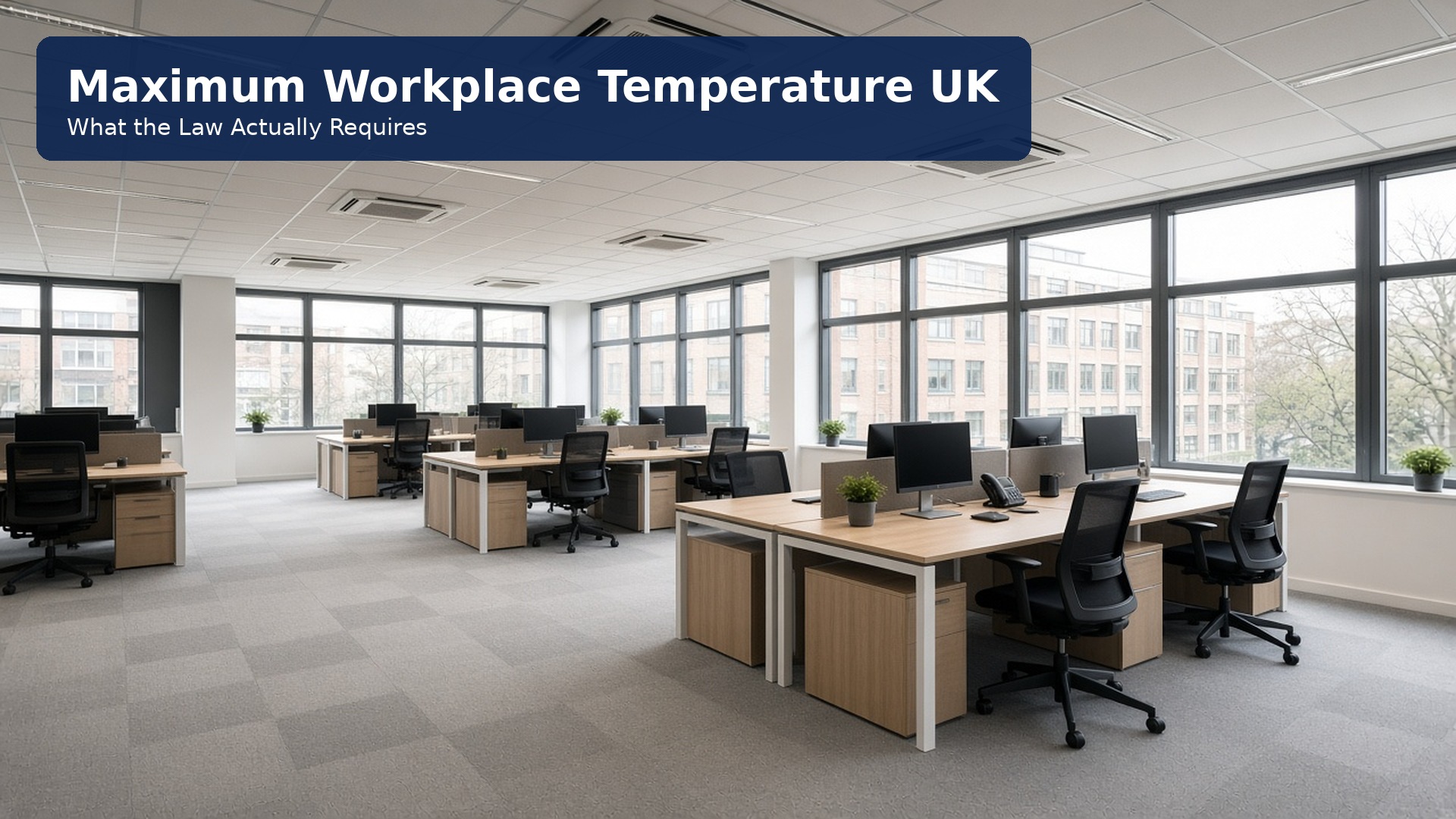
Sedentary desk work usually needs tighter comfort bands than warehouse floors. Solar gain, meeting rooms and IT all create local peaks. Many businesses solve summer complaints with zoned comfort cooling and better controls rather than waiting for a legal maximum that will not arrive.
Warehouses and industrial sites
High roofs, process heat and open doors change the picture. Spot cooling, destratification, ventilation improvements and office-only plant often beat trying to refrigerate an entire shed. Heat risk assessment still matters for people working near hot process or in PPE.
Hospitality and kitchens
Kitchens are process environments. Dining rooms are comfort environments. Extract and make-up air come first for grease and fumes; comfort cooling may still help staff and guests when designed alongside ventilation, not instead of it.
Common myths about maximum workplace temperature UK
| Myth | Reality |
|---|---|
| “Work must stop at 30°C by law” | There is no UK legal maximum workplace temperature. |
| “HSE sets a maximum of 26°C for offices” | HSE states there is no maximum. Guidance minima are about cold conditions (16°C / 13°C). |
| “No maximum means nothing to do in a heatwave” | Heat is still a hazard. Assess, control, consult. |
| “AC is legally required if staff complain” | AC can be an appropriate control. It is not an automatic legal mandate for every premises. |
| “GOV.UK and HSE disagree on the maximum” | Both are aligned: no maximum law or maximum guidance figure. |
If you see a viral post quoting a fixed legal maximum for the UK mainland workplace, treat it as unreliable unless it cites current GOV.UK or HSE text that actually says so. As of the sources above, it does not.
How Commercial AC Installation can help
Commercial AC Installation helps UK businesses arrange support with trusted installers when cooling is a sensible part of heat management. That usually means a free site survey or quote for offices, warehouses, hospitality or mixed premises, framed as one control option among others, not as a substitute for risk assessment.
We will not claim the law forces every business to fit air conditioning, and we will not invent a legal maximum temperature to sell plant. If cooling looks useful, the survey should match the building: cellular offices, open-plan floors, mezzanines, kitchens or packing zones.
When you are ready, contact Commercial AC Installation to request a quote or book a free site survey, or start from commercial air conditioning installation. For existing plant problems see repair and servicing.
Is there a maximum workplace temperature in the UK?
No. There is no law setting a maximum workplace temperature in the UK, and GOV.UK states there is no guidance for a maximum temperature limit. Employers must still keep indoor workplaces at a reasonable temperature, provide fresh air, and assess heat as a health and safety hazard.
What is the minimum workplace temperature in the UK?
There is no law fixing a minimum temperature either. The HSE Approved Code of Practice on the Workplace (Health, Safety and Welfare) Regulations suggests indoor workplaces should normally be at least 16°C, or 13°C if much of the work involves rigorous physical effort. GOV.UK reflects the same guidance figures.
What does the law require if a workplace is too hot?
The Workplace (Health, Safety and Welfare) Regulations require a reasonable indoor temperature. Under the Management of Health and Safety at Work Regulations, employers must assess risks and put controls in place. Heat is a hazard like any other. Controls can include ventilation, shading, work planning, breaks, hydration, PPE review and, where appropriate, cooling or air conditioning.
Does UK law require businesses to install air conditioning?
No. Air conditioning is one possible control where a risk assessment shows it is appropriate. It is not a blanket legal requirement for every office, warehouse or hospitality site. Many workplaces manage heat with ventilation, building controls and working practices first.
What temperatures are reasonable for offices, warehouses and hospitality?
Reasonable depends on the activity and environment. Sedentary office work usually needs cooler conditions than heavy warehouse work. Restaurants mix kitchen process heat with guest comfort. There is no single legal number for hot conditions. Use risk assessment, worker consultation and HSE heat guidance rather than waiting for a statutory maximum that does not exist.
How can Commercial AC Installation help if heat is a problem for our business?
Commercial AC Installation can arrange support with trusted installers for a free site survey or quote where cooling looks like an appropriate control. That sits alongside wider heat management, not instead of risk assessment. Practical options often include office, restaurant or warehouse-focused systems matched to the space.