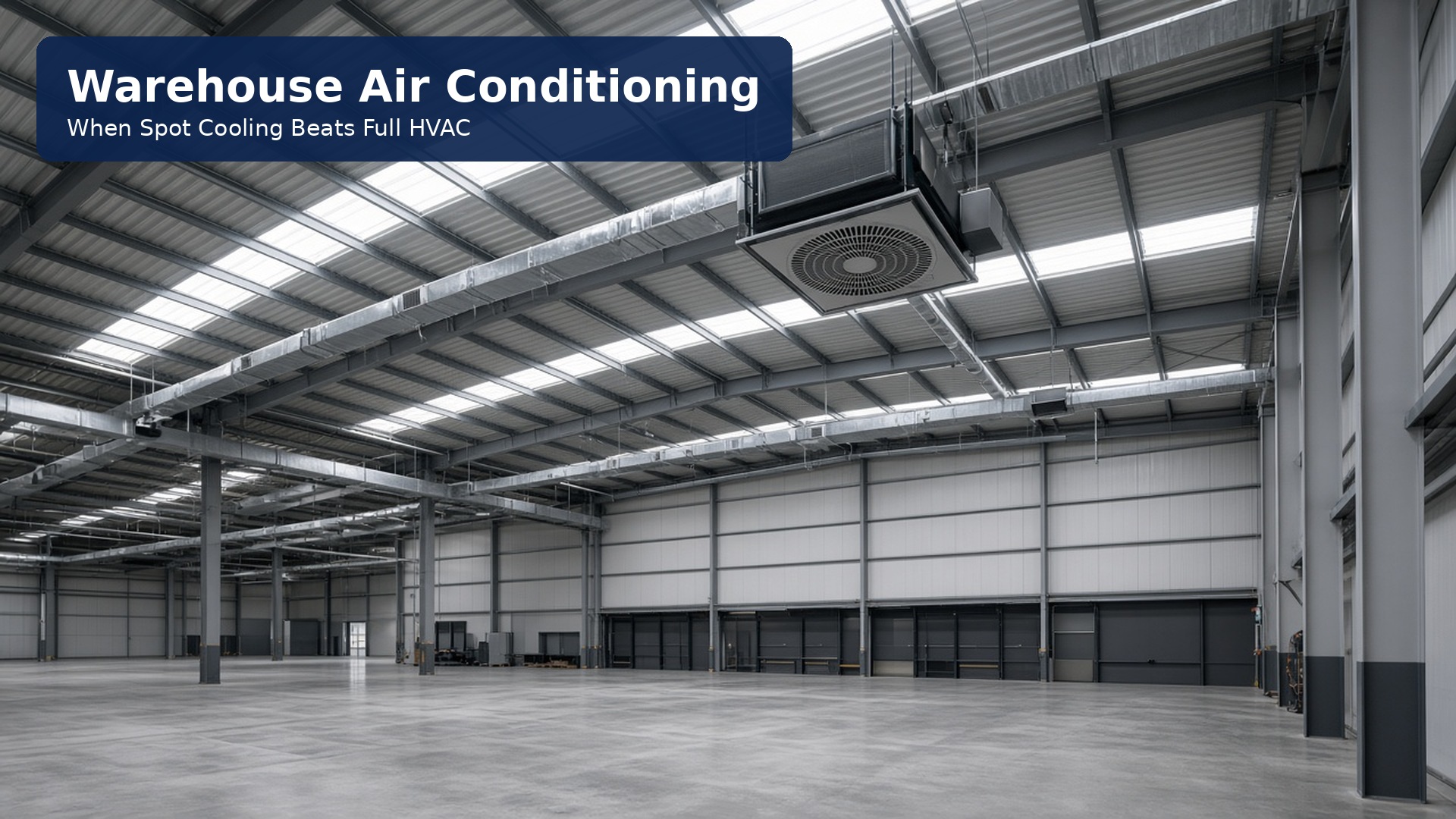
Warehouse air conditioning for UK businesses often starts with the wrong question. People ask how to cool the whole shed. The better question is whether anyone, or any process, actually needs the entire volume cooled, or whether spot cooling, destratification and sensible office plant would do the job.
High roofs, open dock doors and intermittent occupancy make full HVAC expensive to install and run. Spot cooling can protect people where they work without conditioning empty air under the ridge. This guide helps warehouse and industrial businesses decide when spot cooling beats full HVAC, what evaporative options can and cannot do, how to treat mezzanine offices, and what a practical survey should check. Commercial AC Installation can arrange support with trusted installers when you want a site-specific view.
Process heat versus people comfort
Warehouses mix two problems that look the same on a hot day and are not.
Process heat comes from machinery, charging bays, shrink wrappers, lights and solar gain on large roofs. Sometimes stock itself needs temperature limits. Sometimes only operators near a line feel the heat.
People comfort is about staff at packing benches, pick faces, QA stations and offices. The Workplace (Health, Safety and Welfare) Regulations require a reasonable indoor temperature. Guidance suggests minima of 16°C normally, or 13°C for rigorous physical work, and there is no legal maximum temperature. Heat is still a hazard employers must assess and control (GOV.UK workplace temperatures, HSE temperature law). Cooling is one control among ventilation, airflow, breaks, work planning and PPE. Our maximum workplace temperature UK piece covers that framing in more depth.
If you cool “the warehouse” when only a packing line and a mezzanine need comfort, you will overspend. If you ignore radiant heat at a process line, a single wall unit in the corner office will not help the people who need it.
High roofs, destratification and comfort cooling
Warm air rises. In a high-bay building that means a hot cushion under the roof and cooler air lower down in winter, and in summer a large volume that is costly to refrigerate end to end.
Destratification fans push warm air back down in heating season and can improve air movement year-round. They are not air conditioning, but they often belong in the same conversation because they change how temperatures feel at working height.
Comfort cooling for people usually targets zones: packing, picking, goods-in desks, or a defined aisle. Full refrigerant HVAC across the shell can make sense for temperature-controlled storage, high-value goods, or facilities with continuous occupancy and a client brief that demands it. For many general logistics sheds it does not.
Ducted drops from packaged or split plant can serve zones without trying to hold the ridge at 21°C. See ducted air conditioning for how discreet distribution works in commercial buildings. Larger multi-zone needs may point to VRF/VRV for offices and support areas rather than the full warehouse volume.
Spot cooling, evaporative cooling and refrigerant systems
Businesses comparing warehouse air conditioning options usually land in one of these families:
| Approach | Best for | Pros | Cons / when not right |
|---|---|---|---|
| Spot / local refrigerant cooling | Packing lines, pick stations, small work cells | Targets people; lower CapEx than full HVAC; flexible | Will not condition the whole volume; needs outdoor plant or condensers; open dock doors limit effect |
| Ducted zone cooling | Defined areas with plant room or roof space | Tidier distribution; scalable zones | Design and access matter; still not whole-building conditioning unless sized for it |
| Evaporative / adiabatic cooling | Large volumes needing broad tempering in suitable climates | Often lower electrical load for volume tempering | Weaker in humid UK spells; adds moisture; poor fit for close office comfort or humidity-sensitive stock |
| Full HVAC / temperature-controlled warehouse | Spec’d cold chain or climate-controlled storage | Uniform conditions when designed properly | High CapEx and running cost; overkill for many ambient logistics sites |
Evaporative cooling deserves a balanced view. It can be a smart industrial tool where air change rates and humidity allow. It is not a magic low-cost substitute for comfort AC in mezzanine offices, and it is a weak answer when summer humidity is high or stock cannot tolerate added moisture.
Portable spot coolers help temporary peaks or fit-out periods. They are rarely the right permanent answer for multi-shift packing operations.
Mezzanine offices, docks and logistics realities
Most warehouse complaints about “the AC” are really about offices, not the aisle.
Mezzanine offices bake under metal roofs and glass partitions. They need an office-style brief: splits, cassettes or small ducted systems with controls that match occupancy. Link that thinking to our office air conditioning guide rather than trying to drag warehouse air up to desk comfort.
Loading docks defeat cooling strategies that ignore doors. Every time a shutter opens, outdoor air arrives. Zone design should assume that, with local relief near desks that sit beside docks, not a fantasy of sealed-box conditions.
Other survey realities:
- Outdoor plant space on roofs, yards and service yards
- Forklift routes and impact protection around indoor units
- Electrical capacity for new plant
- Noise toward neighbours or on-site offices
- Filter and condenser access without stopping the shift
- Whether maintenance and F-Gas duties are understood before charge sizes grow, see F-Gas regulations
Running cost expectations should be grounded, not brochure-led: commercial air conditioning running costs.
Pros, cons and when warehouse AC is not the right fit
Spot cooling, pros and cons
Pros: Focuses spend on people; faster to deploy; flexible as layouts change. Cons: Limited reach; open buildings dilute the effect; still needs competent design and outdoor plant.
Full warehouse HVAC, pros and cons
Pros: Uniform conditions for climate-controlled briefs; supports certain client and insurer expectations. Cons: High capital and energy use; often unnecessary for ambient logistics; complex to retrofit in busy sheds.
When it is not the right fit
Full warehouse air conditioning is the wrong brief when:
- Only offices and packing need comfort
- Ventilation, shading or destratification would address the main complaint
- Dock doors dominate the thermal behaviour and nobody will change operating practice
- Stock is ambient and the real issue is a hot mezzanine
Spot cooling is the wrong brief when you genuinely need uniform temperature-controlled storage. Be honest about the product brief before you buy plant.
How Commercial AC Installation can help
Commercial AC Installation helps UK warehouse and industrial businesses arrange support with trusted installers. A free site survey or quote typically covers spot versus full HVAC, mezzanine offices, outdoor siting, and a plan that respects docks, forklifts and shift patterns.
We will not push a full-shell scheme where zone cooling would work, or dismiss evaporative options where they genuinely fit. The survey should match the building you run, not a catalogue warehouse.
When you are ready, contact Commercial AC Installation to request a quote or book a free site survey for warehouse air conditioning, or begin via our commercial air conditioning installation page. For plant already on site that needs attention, see commercial air conditioning repair and servicing.
Do warehouses need full air conditioning?
Not always. Many UK warehouses manage with ventilation, destratification fans and targeted spot cooling for people or process hotspots. Full refrigerant HVAC across a high-bay shell is expensive and often unnecessary if only packing lines, offices or a mezzanine need comfort. A survey should separate people comfort from process heat before you buy plant.
What is spot cooling in a warehouse?
Spot cooling delivers cooled air to a defined work zone such as a packing bench, picking aisle or loading office, rather than conditioning the entire volume under the roof. It can use local splits, ducted drops or industrial spot coolers. It works best when the rest of the building can stay warmer without creating an unsafe or unworkable environment.
Is evaporative cooling suitable for UK warehouses?
Evaporative (adiabatic) cooling can suit some large, well-ventilated industrial spaces in dry conditions and can use less electricity than refrigerant cooling for broad volume tempering. It is less effective in humid weather, adds moisture to the air, and is not a like-for-like replacement for close comfort control in offices or humidity-sensitive stock. Treat it as one option among others, not a universal answer.
How should businesses cool mezzanine offices in a warehouse?
Mezzanine and perimeter offices usually need ordinary comfort cooling and heating, closer to an office brief than a high-bay scheme. Wall splits, cassettes or small ducted systems are common. Keep office plant separate from any warehouse spot-cooling strategy so office setpoints do not try to fight the open warehouse volume. See our office air conditioning guide for layout options.
What should a warehouse air conditioning survey check?
A useful survey looks at roof height, insulation, process heat sources, occupancy patterns, dock doors, mezzanine offices, outdoor plant space, electrical capacity, noise and whether the real need is people comfort, process cooling or both. It should also flag when destratification or ventilation changes would achieve more than adding refrigerant plant.
How can Commercial AC Installation help with warehouse air conditioning?
Commercial AC Installation can arrange support with trusted installers for a free site survey or quote. That typically covers spot versus full HVAC options, mezzanine offices, outdoor siting and a practical plan for occupied logistics space.