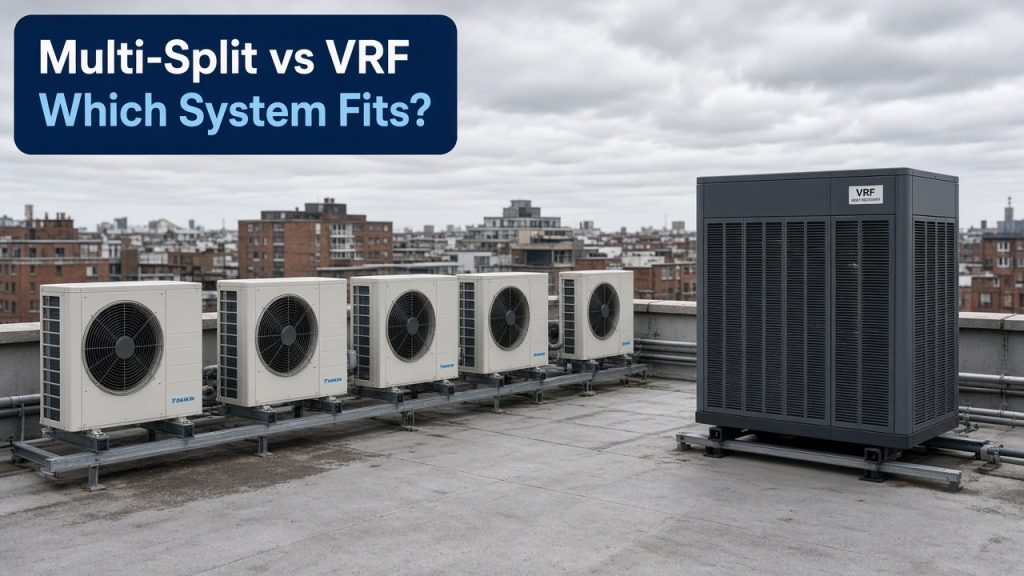
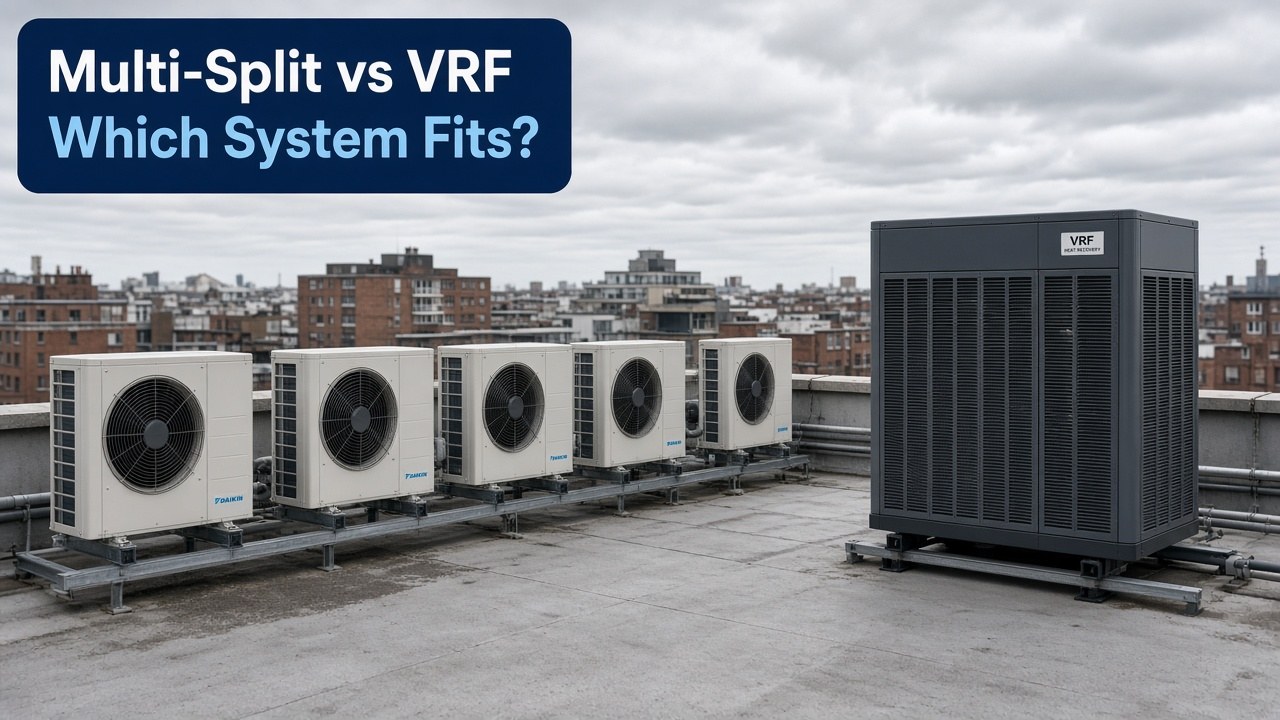
Multi-split vs VRF is the decision fork that stalls a lot of commercial specs. Both let UK businesses put several indoor units on shared outdoor plant. Pick wrong and you either stretch a multi split air conditioner setup past its comfort, or pay for VRF features your floor plate never uses.
This guide is a decision framework: zones, outdoor footprint, pipe length, controls, cost-band orientation (illustrative only), efficiency, maintenance, a full comparison table, and balanced pros and cons for each. Commercial AC Installation can arrange support with trusted installers when you want the choice grounded in a free site survey, not a brochure.
Multi-split and VRF in plain English
Multi-split: One outdoor unit serves a limited number of indoor units (wall, cassette, ducted and others depending on the range). It is the natural step up from several separate single splits when you want fewer condensers.
VRF / VRV: Variable Refrigerant Flow (Daikin’s trademarked VRV ≈ VRF) modulates refrigerant across a larger network of indoors, with design tools aimed at longer pipes, higher indoor counts and more sophisticated zoning. Heat pump VRF typically runs connected zones in the same mode; heat recovery VRF can heat and cool different zones simultaneously. Deeper primer: VRF and VRV explained for businesses.
Neither system removes the need for outdoor space, electrical capacity, condensate routes or F-Gas certified installers.
Big comparison table
| Factor | Multi-split | VRF / VRV |
|---|---|---|
| Typical scale | Small–mid commercial suites, several rooms | Mid–large floors, multi-zone fit-outs |
| Indoor count | Several per outdoor (manufacturer-limited) | Higher counts; scalable outdoor platforms |
| Zoning | Room-by-room setpoints; usually same mode | Strong zoning; heat recovery can do opposite modes |
| Simultaneous heat + cool | Generally no | Yes on heat recovery systems |
| Pipe length / height | Shorter practical envelopes | Longer allowable networks when designed correctly |
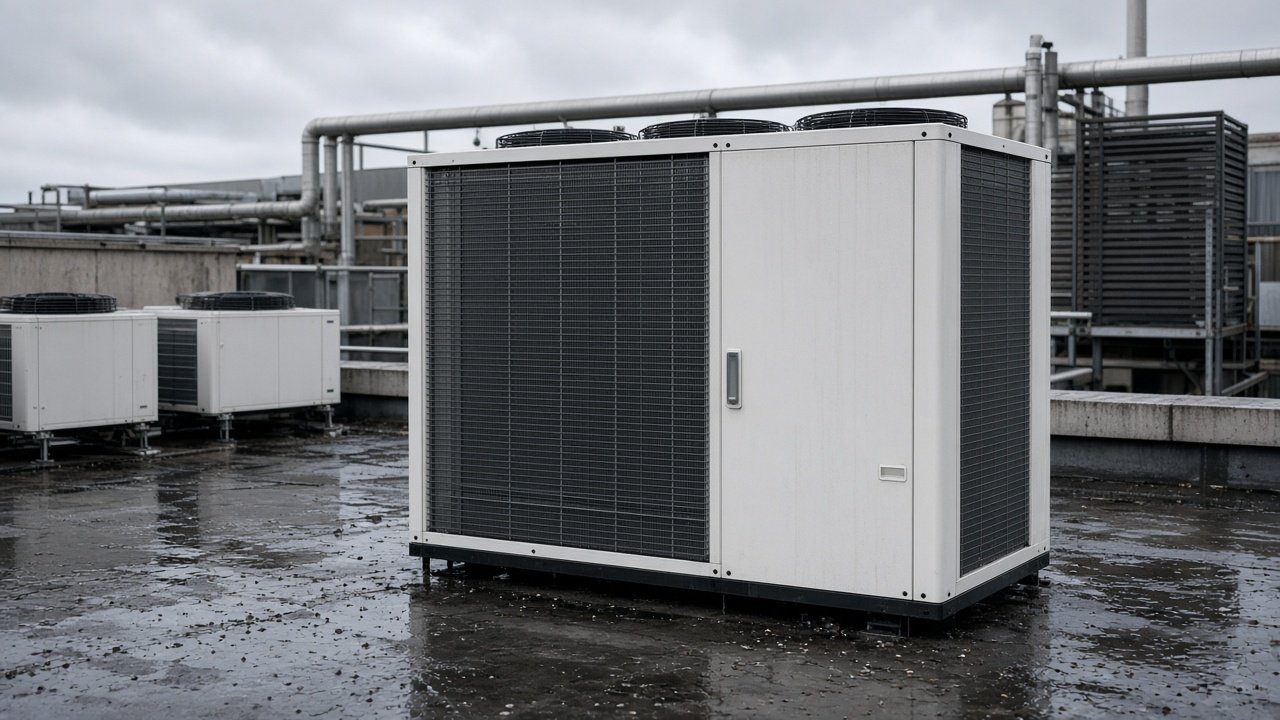
| Outdoor footprint | One condenser for a small group; multiple multi-splits if you grow | Fewer, larger outdoor units relative to many splits |
| Controls | Good local/group controls; simpler central options | Stronger central/BMS-oriented control suites |
| Design dependency | Important but usually simpler | High — diversity, oil return, branches matter |
| CapEx band (orientation) | Usually lower for small jobs | Usually higher; can be better value at scale |
| Running cost drivers | Efficiency + controls + maintenance | Often strong part-load efficiency if commissioned well |
| F-Gas attention | Applies; charge often smaller | Applies; larger charges often mean more leak-check discipline |
| Best not used when | You need opposite modes or long networks | Brief is one room or a tiny suite |
Cost bands above are illustrative orientation only, not quotes. For CapEx drivers see commercial air conditioning cost UK; for energy behaviour see running costs.
Zones and how people actually use the building
If your businesses’ premises are a handful of cellular offices and a meeting room that all cool together on hot afternoons, multi-split zoning is often enough: each room can have its own setpoint, but the system is still in cooling mode.

If you have deep-plan floors where the glazed perimeter wants cooling while a shaded core still wants heat in shoulder seasons, heat recovery VRF earns the premium. Buying heat recovery “just in case” when modes never conflict is how CapEx disappears.
Open-plan fit-outs also need honest conversation about indoor type — cassette, ducted or wall — which is a parallel choice to multi-split versus VRF. See office air conditioning and ducted air conditioning.
Outdoor footprint and planning reality
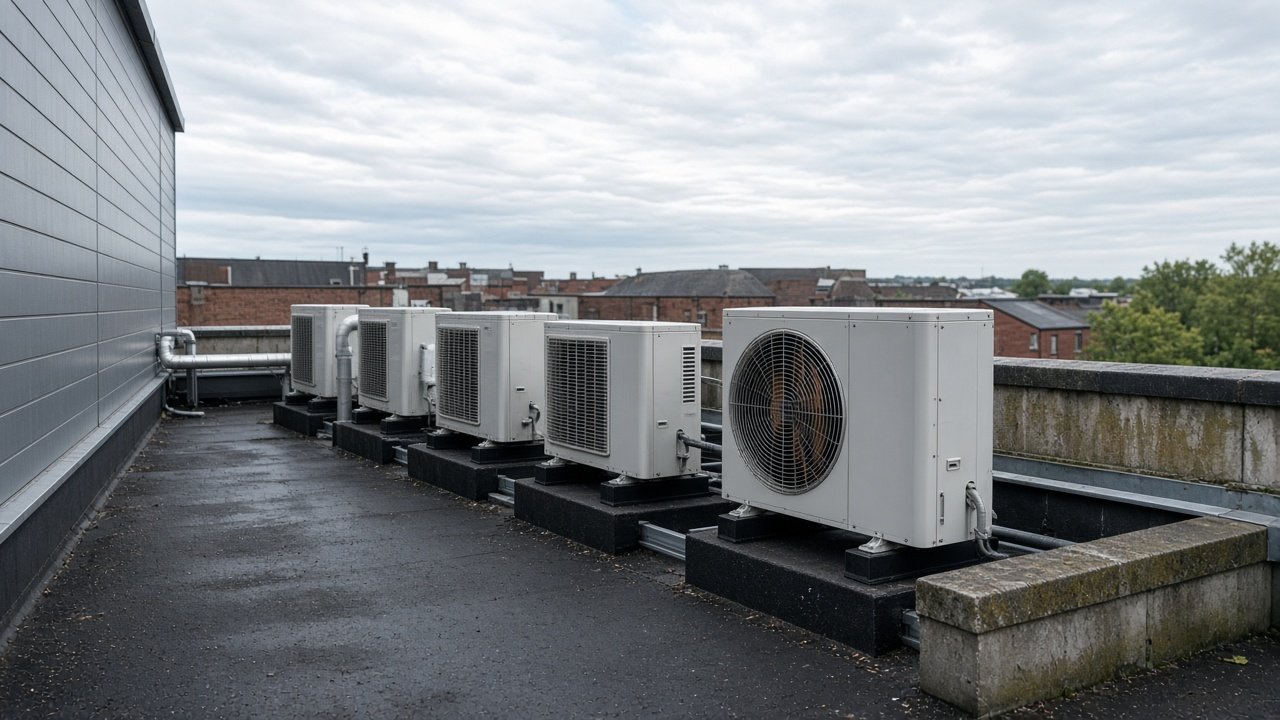
Multi-splits reduce condenser clutter versus one outdoor per room. Grow too far with multiple multi-split outdoors and you recreate the clutter problem VRF was meant to solve.
VRF outdoor units are larger per machine but fewer relative to a big indoor count. They still need airflow, structural support (especially on roofs), service access and acoustic thought.
Commercial outdoor plant often needs planning permission; domestic permitted development rights usually do not apply the same way. Landlord consent is separate. Noise is commonly assessed using approaches such as BS 4142 — do not treat a single dB number as nationwide law. Check the local planning authority; this is practical guidance, not legal advice.
Pipe length, height and design risk
This is where multi-splits quietly fail on ambitious drawings. Every manufacturer publishes length and rise limits. Exceed them on paper and you get oil return issues, capacity loss or a late redesign.
VRF is built for longer networks, but it is not a licence to improvise. Branch placement, pipe sizing and commissioning still decide whether the system feels premium or problematic. Cheap design is the most expensive line item on either technology.
Controls, efficiency and maintenance
Controls: Multi-splits offer solid local and group control. VRF usually offers richer central scheduling, monitoring and BMS integration — valuable on larger sites, optional overhead on a three-room suite.
Efficiency: Both modern inverter platforms can be efficient. VRF often looks stronger at part load across diverse zones when diversity is real and controls are set properly. A multi-split on a sensible schedule can beat a poorly controlled VRF left blasting empty floors. Maintenance and filters matter on both; see commercial air conditioning maintenance.
F-Gas: Operator duties apply to both. Leak checks are generally required from 5 tCO₂e (hermetically sealed thresholds differ per GOV.UK), with frequency by CO₂e band and certified people keeping records. Larger VRF charges often mean more formal leak-check planning — not an exemption. TM44 energy inspections (England and Wales, combined effective rated output more than 12kW, no more than five years apart) remain a separate duty from F-Gas and from servicing (GOV.UK AC inspections).
Pros and cons
Multi-split — pros
- Lower CapEx band for small-to-mid commercial jobs
- Fewer outdoor units than a cluster of single splits
- Familiar indoor choices (wall, cassette, ducted)
- Faster, simpler projects when pipe lengths fit
Multi-split — cons
- Indoor count and pipe envelopes are limited
- Usually no simultaneous heating and cooling across rooms
- Scaling by adding more multi-split outdoors recreates plant clutter
- Less ideal for complex multi-floor diversity
VRF — pros
- Scales to larger indoor counts and longer networks
- Excellent zoning; heat recovery for genuine mixed modes
- Strong central control options
- Efficient part-load performance when designed and commissioned well
VRF — cons
- Higher upfront cost and design dependency
- Overkill for small single rooms or tiny suites
- Larger refrigerant inventories mean stricter F-Gas discipline
- Commissioning and specialist diagnostics matter more
Decision framework for businesses
Use this as a working checklist:

- How many rooms/zones need independent setpoints — and do any need opposite modes at once?
- Pipe length and vertical rise — do multi-split limits look comfortable with margin?
- Outdoor space and planning/landlord constraints — fewer larger units vs several smaller ones?
- Controls ambition — simple remotes or central/BMS schedules?
- Budget and programme — can you fund proper VRF design, or is multi-split the proportionate spend?
- Future expansion — will you add wings or floors in two years?
- Maintenance capability — who will hold records and attend filters, drains and leak checks?
Rough rule of thumb (not a law of physics): if the brief is a small suite with short pipes and same-mode operation, start with multi-split. If the brief is a diverse floor plate, long runs or simultaneous heat/cool, start with VRF and prove whether heat pump or heat recovery is justified.
When plant is ageing, the choice may also be phased replacement versus full renew — repair or replace.
When neither (or not yet) is the right fit
- A single room often needs one split, not a multi-split platform
- If outdoor plant is impossible and no alternative strategy exists, pause before forcing either system
- If the building already has workable plant, fix controls and maintenance before a brand-led upgrade
- If heat recovery VRF is quoted but shoulder-season data shows no opposite-mode hours, challenge the spec
How Commercial AC Installation can help
Commercial AC Installation can arrange support with trusted installers to compare multi-split and VRF options against your real constraints: zones, pipe routes, outdoor footprint, noise/planning caveats and budget. Request a quote or a free site survey — and treat any pound figures as illustrative until someone has walked the building.
The goal is the smallest system that still fits how your businesses use the space for the next decade, not the largest acronym in the tender pack.
What is the difference between multi-split and VRF for businesses?
Both connect multiple indoor units to outdoor plant, but VRF (including Daikin VRV) is generally built for larger systems, longer pipe runs, finer zoning and stronger part-load control. Multi-splits suit smaller suites where several rooms share one outdoor unit without needing full VRF complexity or simultaneous heat/cool across zones.
Can a multi-split heat and cool different rooms at the same time?
Typically no. Most multi-splits operate connected indoor units in the same mode — all heating or all cooling. Heat recovery VRF can heat some zones while cooling others. If simultaneous opposite modes matter for your building, that usually points toward heat recovery VRF rather than a standard multi-split.
Which is cheaper: multi-split or VRF?
Multi-splits usually sit in a lower capital-cost band for small-to-mid commercial jobs. VRF often costs more upfront but can be more proportionate for larger floors, longer pipes and complex zoning. Treat any £ figures as illustrative only — a site survey decides the real number for your premises.
How many indoor units can a multi-split support compared with VRF?
Multi-splits support several indoors on one outdoor unit within manufacturer limits. VRF platforms are designed to scale to higher indoor counts and longer networks. Exact limits depend on the model range — compare manufacturer design tools rather than a single internet rule of thumb.
Is VRV different from VRF in this comparison?
VRV is Daikin’s trademarked name for variable refrigerant technology; other brands use VRF. For a multi-split versus VRF decision, treat VRV as part of the VRF family and compare heat pump versus heat recovery, pipe design and controls.
How can Commercial AC Installation help choose multi-split or VRF?
Commercial AC Installation can arrange support with trusted installers for a free site survey or quote that compares multi-split and VRF options against your floor plate, outdoor space, pipe routes and budget — without forcing the larger system if a multi-split meets the brief.