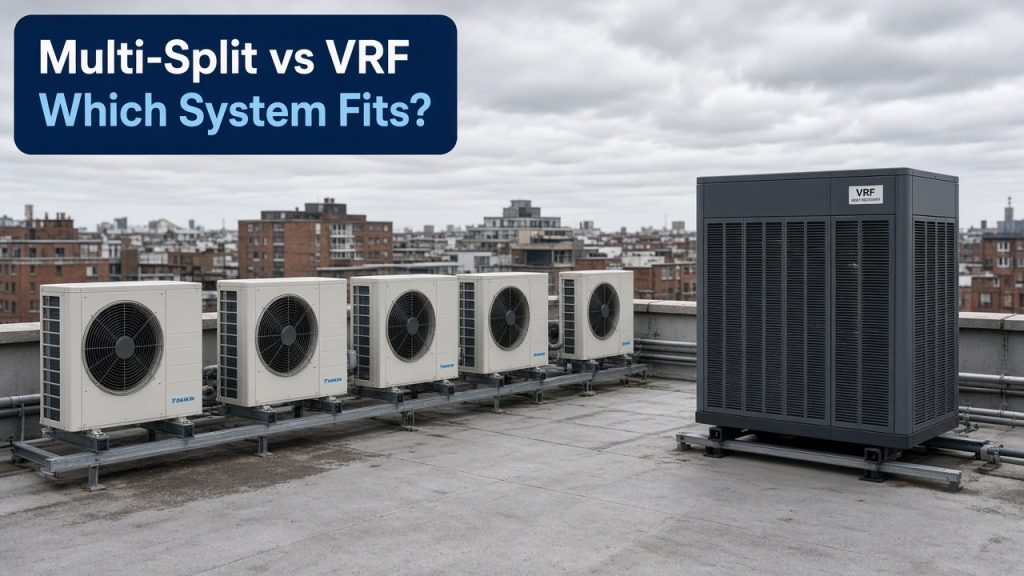
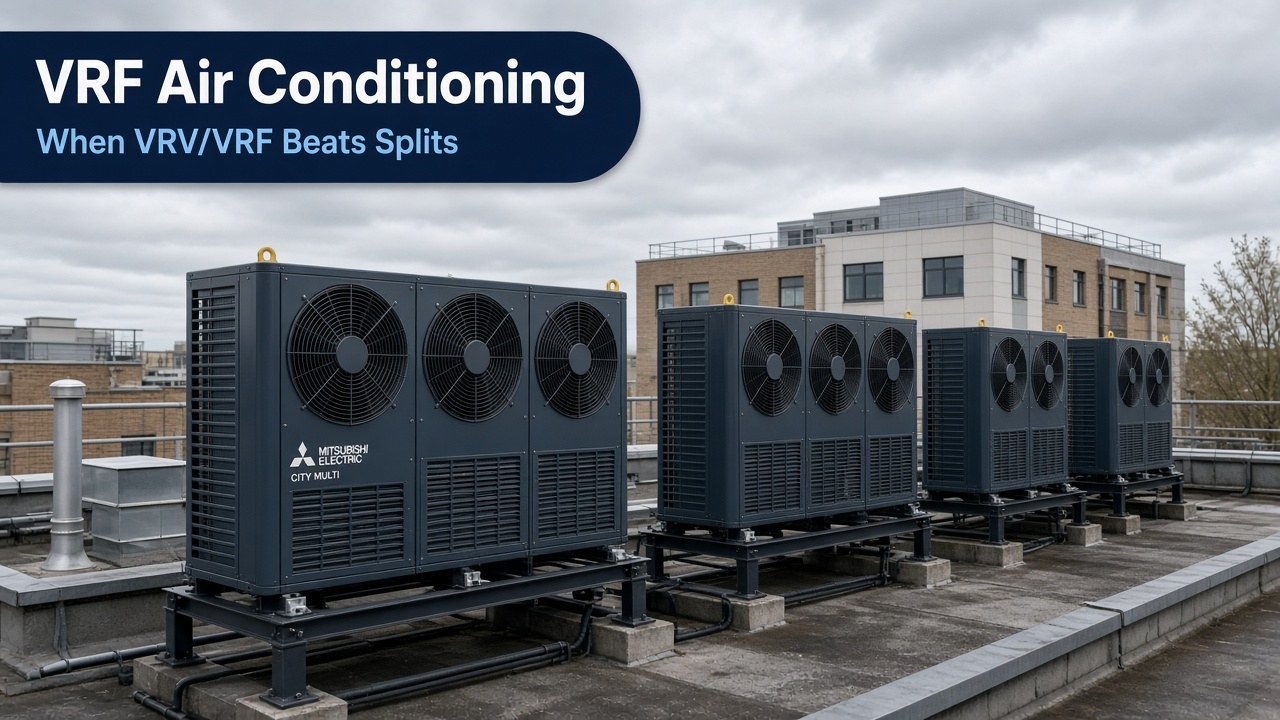
VRF air conditioning starts to matter when multi-zone UK businesses outgrow a cluster of splits — too many outdoor units, pipe runs that will not stretch, or rooms that need proper independent control. VRV is Daikin’s name for the same family of technology (treat VRV ≈ VRF early and move on to the real decision).
This guide shows when VRF/VRV beats splits or multi-splits, how heat pump and heat recovery differ, install and F-Gas realities at scale, balanced pros and cons, and when VRF is not the right fit. Commercial AC Installation can arrange support with trusted installers if you want a survey before the acronym hardens into a tender.
What VRF (and VRV) actually means
VRF stands for Variable Refrigerant Flow. One or more outdoor units serve multiple indoor units (wall, cassette, ducted, floor and others) and modulate refrigerant so each zone can track demand more closely than old on/off plant.
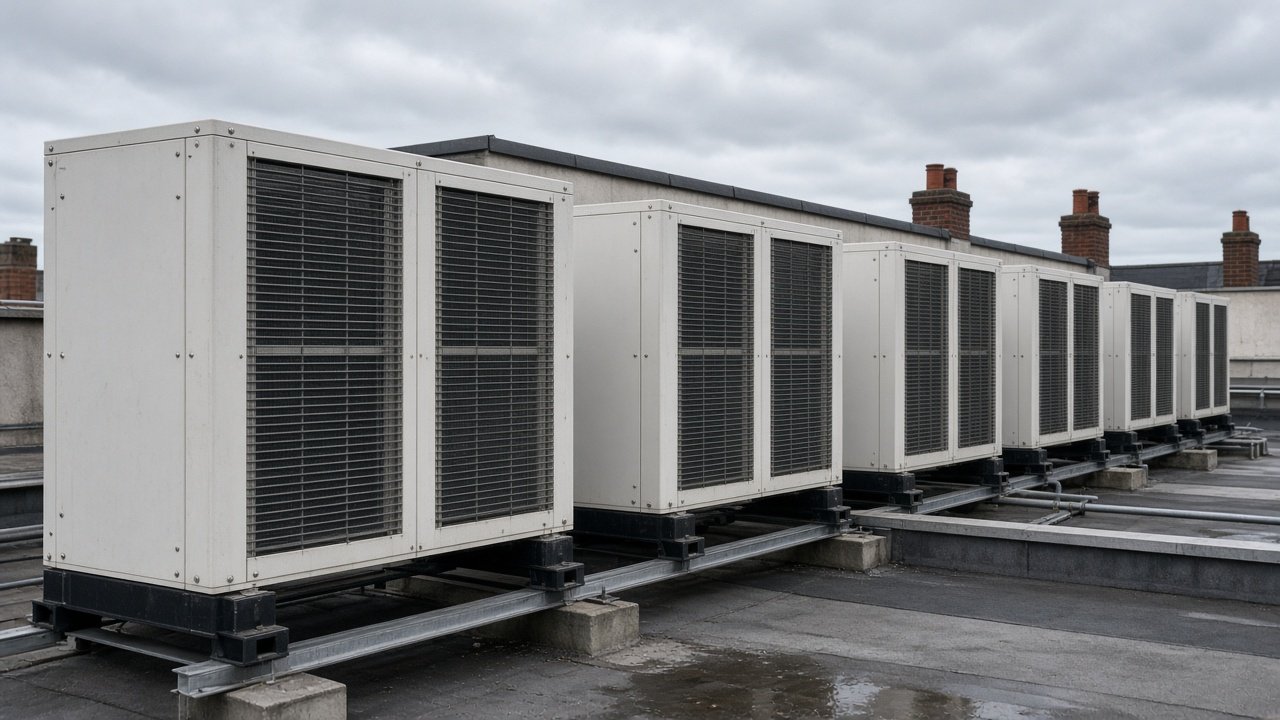
VRV — Variable Refrigerant Volume — is Daikin’s trademarked name for essentially the same concept. In day-to-day conversation for businesses, treating VRV ≈ VRF is fine. Spec sheets and warranties still care about the manufacturer; your comfort and energy outcome care more about design, controls and maintenance.
Why businesses choose it:
- Many indoor units without a forest of condensers
- Zoning across offices, meeting rooms and perimeter areas
- Longer allowable pipe runs than typical multi-splits
- Strong part-load efficiency when the system is designed and commissioned properly
- Heating and cooling from the same heat-pump outdoor plant
It is still a refrigerant-based system. It is not magic comfort that ignores outdoor space, noise, electrical supply or ceiling access.
Heat pump VRF vs heat recovery VRF
This is the decision that actually changes CapEx and energy behaviour.
| Feature | Heat pump VRF | Heat recovery VRF |
|---|---|---|
| Mode behaviour | Connected indoors typically heat or cool together (same mode) | Can heat some zones while cooling others at the same time |
| Best for | Buildings with broadly similar seasonal needs across zones | Mixed gains: sunny perimeter cooling while core or north rooms still need heat |
| Complexity | Simpler branch layout | Branch controllers / BS boxes and more design care |
| CapEx orientation | Lower than heat recovery for similar capacity (illustrative — site survey decides) | Higher upfront |
| Energy angle | Efficient when modes align with the season | Can reclaim heat between zones when simultaneous demand is real |
| When it underperforms | If you truly need opposite modes often | If simultaneous demand is rare — you paid for a feature you barely use |
Heat recovery is not automatically “better.” It is better when your building actually runs opposite modes for meaningful hours — think deep-plan offices with strong solar gain on one face, or mixed retail and back-of-house. If everyone cools in summer and heats in winter together, heat pump VRF is often the proportionate choice.
When businesses need VRF air conditioning
VRF earns its keep when:
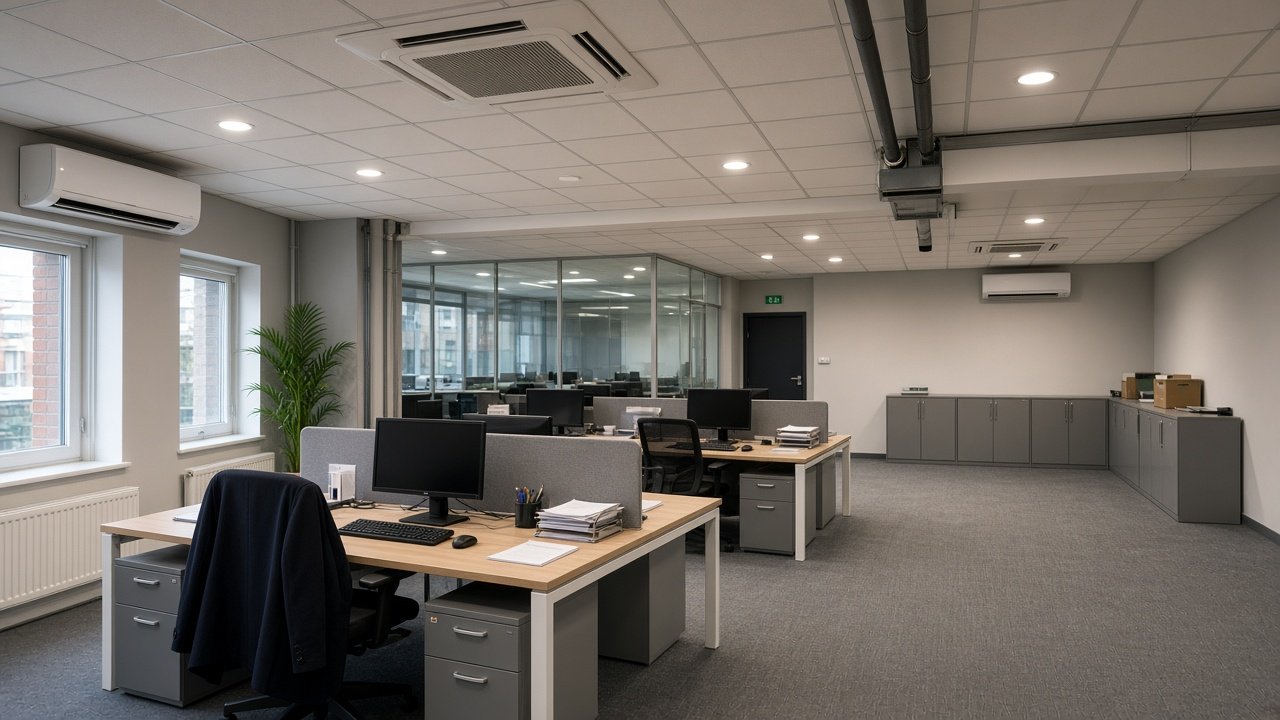
- Indoor count and diversity outgrow a sensible multi-split
- Pipe lengths or vertical rises stretch multi-split limits
- You need finer zoning and centralised control across floors
- Outdoor plant space is constrained and you want fewer, larger condensers
- The project may expand in phases on the same outdoor platform
It is usually overkill when:
- You have one or two rooms
- A simple multi-split covers the brief with shorter pipes
- Budget and programme cannot absorb proper design and commissioning
For a direct comparison on zones, footprint and cost orientation, see multi-split vs VRF for businesses. For general office system choices, our office air conditioning guide sits alongside this one.
Install considerations that decide success
A VRF quote is only as good as the design behind it.
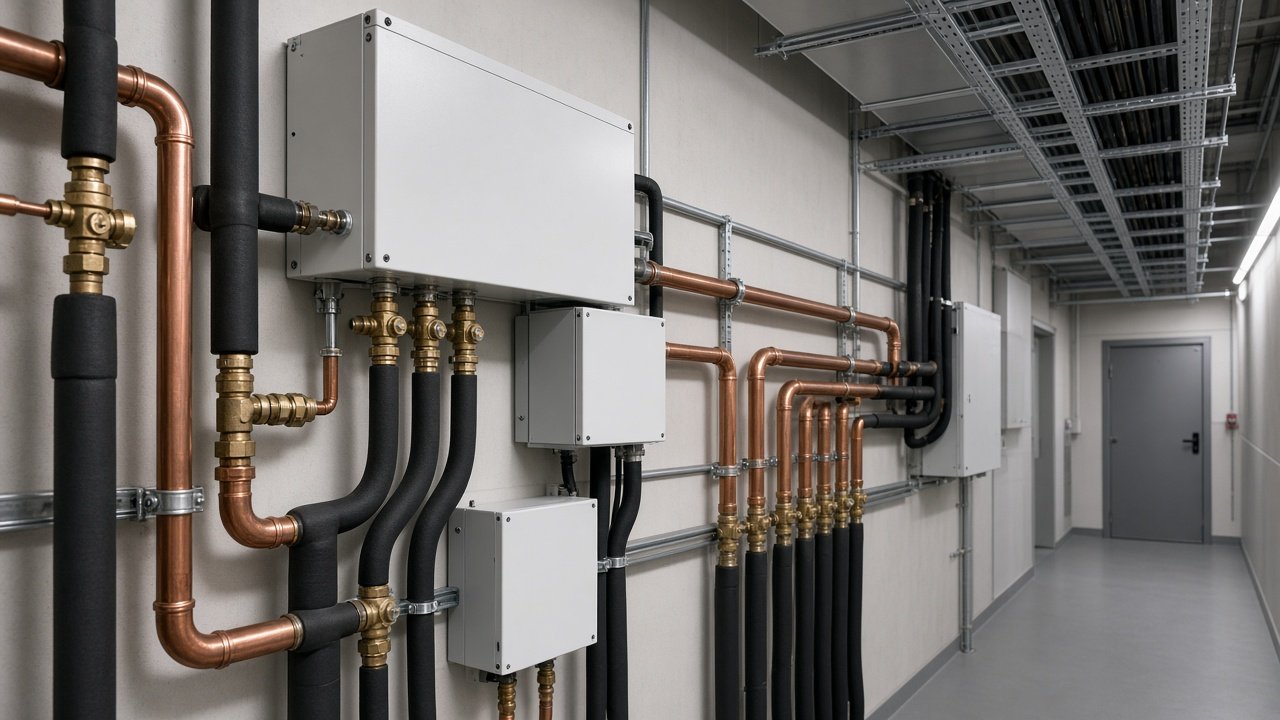
Design and survey should cover heat gains, diversity, indoor unit selection, outdoor siting, refrigerant pipe routes, oil return, controls strategy and electrical capacity. Undersized pipework, poor branch placement or optimistic diversity assumptions show up later as comfort complaints and compressor stress.
Outdoor units need airflow, service access and acoustic consideration. Roof plant often needs structural and waterproofing attention. Yard plant needs security and neighbour noise thought. Commercial outdoor plant often needs planning permission — domestic permitted development rights usually do not apply the same way — and landlord consent is a separate track. Noise is commonly assessed using approaches such as BS 4142; there is no single nationwide dB legal limit for every site. Check your local planning authority; this is practical guidance, not legal advice.
Disruption in occupied premises is real: ceiling access for pipes and branch controllers, crane or lift slots for outdoor units, and commissioning time when the system must run through its checks. Phasing helps; pretending VRF installs like a single wall split does not.
Controls are half the product. Central controllers, schedules, setbacks and integration with BMS (where you have one) determine whether you get the efficiency the brochure hinted at. For how that lands on the bill, read commercial air conditioning running costs.
Commissioning by competent, F-Gas certified engineers is non-negotiable. Vacuum integrity, charge accuracy and control setup are where cheap installs cut corners. Standard commercial AC refrigerant work is an F-Gas competence issue — do not assume an MCS badge is the relevant commercial AC requirement unless your project specifically sits in that scoped territory.
F-Gas and leak checks at VRF scale
Larger systems usually mean larger refrigerant charges — and under UK F-Gas rules the operator (typically the business with technical control of the kit) has duties for stationary air conditioning and heat pumps.
Practical points aligned with GOV.UK leak-check guidance:
- Leak checks are generally required from 5 tCO₂e (hermetically sealed equipment has different thresholds noted on GOV.UK — commonly discussed from 10 tCO₂e for that hermetic exception)
- Frequency is driven by CO₂-equivalent charge, roughly: 5–<50 tCO₂e at least every 12 months; 50–<500 at least every 6 months; 500+ at least every 3 months
- Working automatic leak detection can double those intervals; systems at 500+ tCO₂e generally need automatic leak detection fitted
- Installation, maintenance, leak repair and recovery must be done by appropriately certified people and companies
- Keep the required records
A modern VRF badge does not remove operator duties. Prefer checking GOV.UK for current detail rather than converting every refrigerant into homemade kilogram rules of thumb.
TM44 energy inspections (where combined effective rated cooling output is more than 12kW in England and Wales) are a separate compliance track from F-Gas leak checks and from routine servicing. GOV.UK notes a £300 fine if you do not get inspected every five years where required. Scotland and Northern Ireland can differ — focus on England and Wales guidance unless your site is elsewhere. See F-Gas regulations for commercial air conditioning and TM44 air conditioning inspection.
Pros and cons of VRF for businesses
Pros
- Excellent zoning and comfort flexibility across varied spaces
- Fewer outdoor units relative to many separate splits
- Strong part-load efficiency when designed and controlled well
- Heat recovery option where simultaneous heating and cooling is genuine
- Scalable platforms for phased fit-outs
Cons
- Higher capital cost than simple splits or small multi-splits
- Design and install quality matter more — mistakes are expensive
- Larger refrigerant inventories mean stricter F-Gas discipline
- Repairs can be more specialised; diagnostics need trained engineers
- Heat recovery complexity is wasted if modes rarely conflict
When VRF is not the right fit
Skip VRF (or at least pause) when:

- The brief is a single room or a very small suite — a wall split or cassette is usually enough
- A multi-split covers capacity and pipe length without strain
- There is no credible outdoor location, planning route or electrical capacity for the outdoor plant
- The budget only covers equipment, not design, access equipment and proper commissioning
- The real problem is controls or maintenance on existing plant, not a lack of VRF brand names
Sometimes repair, better schedules or replacing the worst indoor zones first is smarter than a full VRF rip-and-replace. That conversation sits in repair or replace commercial air conditioning. For CapEx orientation, use commercial air conditioning cost UK — any £ figures you see elsewhere should be treated as illustrative only; a site survey decides the real number.
How Commercial AC Installation can help
Commercial AC Installation can arrange support with trusted installers who design and install VRF and VRV for commercial premises. Expect a survey-led view of heat pump versus heat recovery, outdoor siting, controls and whether a simpler system would meet the same brief.
Request a quote or a free site survey when you want clarity before the specification hardens. Good VRF projects start with the building’s diversity and pipe routes, not with the loudest brochure.
What is VRF air conditioning?
VRF (Variable Refrigerant Flow) is a commercial system that varies refrigerant flow to multiple indoor units from one or more outdoor units. It supports zoning, longer pipe runs than typical multi-splits and efficient part-load operation. Businesses use it for offices, retail floors and mixed-use premises that need flexible heating and cooling.
Is VRV the same as VRF?
Functionally yes for most buyers. VRV (Variable Refrigerant Volume) is Daikin’s trademarked name for the same family of technology. Other manufacturers use VRF. When comparing quotes, focus on heat pump versus heat recovery, design quality and controls rather than the label alone.
What is the difference between heat pump VRF and heat recovery VRF?
Heat pump VRF typically heats or cools all connected indoor units in the same mode at a given time. Heat recovery VRF can heat some zones while cooling others simultaneously, often via branch controllers, which suits buildings with mixed gains. Heat recovery costs more upfront and needs a clear simultaneous-demand case.
When do businesses need VRF rather than multi-split?
VRF tends to fit larger floor plates, more indoor units, longer pipe runs, stronger zoning needs and projects where outdoor footprint or future expansion matters. Small single rooms or a handful of cellular offices are often better served by splits or multi-splits.
Do VRF systems need special F-Gas attention?
Larger refrigerant charges make UK F-Gas operator duties more important: leak checks are generally required from 5 tCO2e (with different hermetically sealed thresholds noted on GOV.UK), at frequencies based on CO2-equivalent charge, by certified people, with records kept. A modern VRF badge does not remove those duties. See GOV.UK guidance on checking F-Gas equipment for leaks.
How can Commercial AC Installation help with VRF or VRV?
Commercial AC Installation can arrange support with trusted installers for design advice, surveys and quotes on VRF or VRV for your premises. That includes whether heat pump or heat recovery fits, outdoor siting and a realistic view of cost and disruption before you commit.